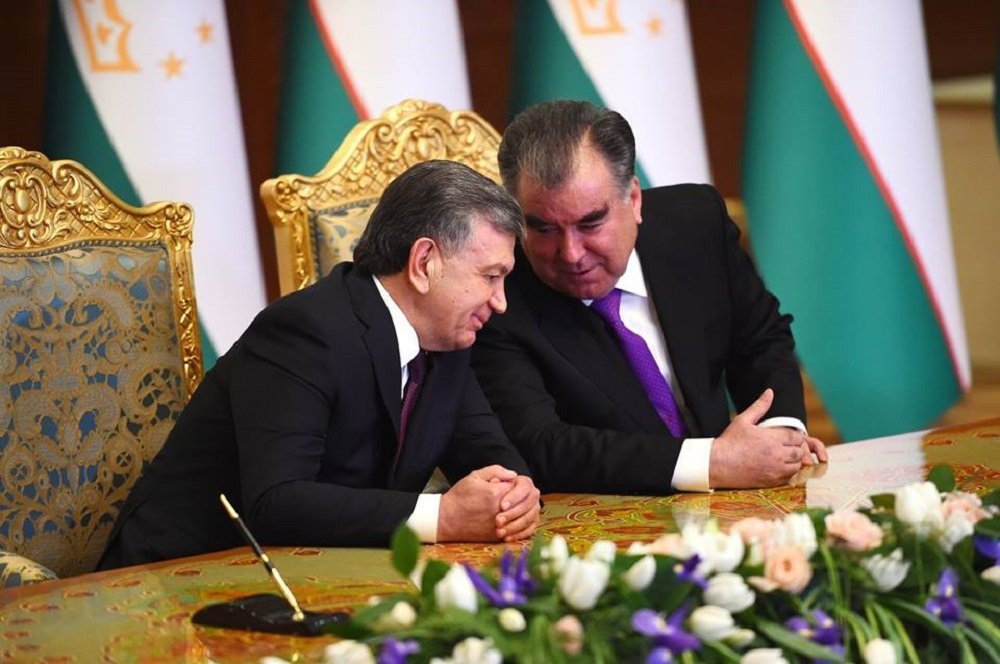
Tajikistan and Uzbekistan intend to sign a government-to-government agreement on jointly deterring external aggression. This agreement is expected to be signed during Tajik president’s state visit to Uzbekistan, a source in the Tajik Government told Asia-Plus in an interview.
According to him, twenty-three new cooperation documents will be signed during Emomali Rahmon’s state visit to Uzbekistan, which is scheduled for the second half of August.
“Besides agreements on cooperation in the field of security, Dushanbe and Tashkent are also expected to sign documents on cooperation in the fields of cinematography and hydrometeorology,” the source noted.
The two countries will also sign an agreement strategic partnership between and an agreement on completion of delimitation and demarcation of the mutual border.
“Uzbekistan has repeatedly expressed wish to study Tajikistan’s experience in regulating traditions and rituals. Dushanbe and Tashkent are expected to sign an agreement on cooperation in this area,” the source added.
Recall, the law on traditions and rituals which was adopted by Tajikistan in 2007, regulates private celebrations, including religious celebrations, allegedly to protect people from spending excessive amounts of money.
The two nations have accumulated many problems after collapse of the Soviet Union. These problems caused the countries' relations to go into a deep freeze two decades ago, including disputes over water and borders. The two countries had had the worst bilateral relations in Central Asia. With the election of Shavkat Mirziyoyev as President of Uzbekistan Uzbek-Tajik relations, as well as relations between Uzbekistan and its neighbors in Central Asia, reached a new era of potential.
Mirziyoyev and Emomali Rahmon have met several times since September 2016, and in March 2018, Mirziyoyev made an historic visit to Dushanbe, where 27 bilateral agreements were signed in the fields of trade, economy, investment, finance, transport and transit, agriculture, water and energy, taxes, customs, tourism, education and science, health, culture, interregional cooperation, in the field of security and countering crime.