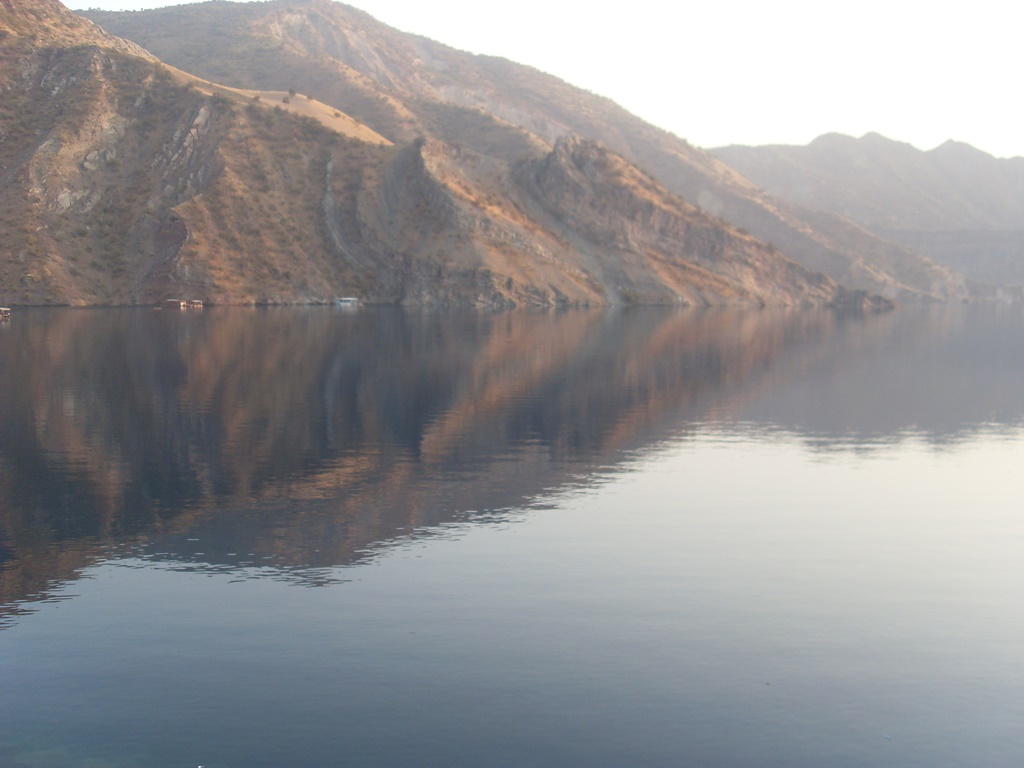
The maximum mark of occupancy of the reservoir of the Nurek HPP was reached as early as the end of August of this year.
At the end of August 2018, the water level in the reservoir of the Nurek HPP was 910.45 m, – the report "Monitoring and early warning in Tajikistan, prepared by the Ministry of Economic Development and Trade says.
This is the maximum filling level of the Nurek reservoir: it has a normal retaining level of 910 meters.
The water level is 53.45 m above the "dead mark" (857 m), at which the exploitation of the reservoir is prohibited according to technical parameters.
The average monthly inflow of the Vakhsh River in August this year was 1382 cubic meters per second, which is 6.4% less than in the same period last year.
In September, the inflow of water usually decreases to 600 cubic meters per second, and in the first ten days of October – up to 400 cubic meters per second, after which the use of water resources accumulated in the reservoir begins.
Meanwhile, it was previously reported that in the Kulyab region for several days there was no light: it was turned off by the clock from 5 to 8 am, and in the evening – from 17 to 24 hours. Specialists of "Barki Tojik" stated that this is not a power utility, but only prevention, associated with the preparation for winter.
In local power grids of Kulyab reported last week that they received an oral instruction from the management of Barki Tojik to turn off the light supply by the clock. This, allegedly, is associated with the receipt of a small amount of water in the Nurek reservoir.
«Soon, the first unit of the Rogun hydroelectric power station is expected to be put into operation, therefore part of the water remains in the Rogun reservoir, and the inflow of water into the Nurek reservoir has decreased», – said deputy head of “Shabakahoi barki Kubol” LLC Zarif Tabarov.
Information on the filling of the Rogun Reservoir, which leads to a decrease in the inflow of water from the Vakhsh River, was confirmed on the condition of anonymity by specialists in the energy structures of the country.
The first unit of the Rogun HPP is scheduled to be launched on November 16 this year.
The rotor of the unit No. 6, which will be commissioned first, was installed in its regular place in early July this year. It is expected that at the initial stage after the launch, the unit's capacity will be 100 MW. The design capacity is 600 MW.
Next, in April next year, is planned to put into operation the unit number 5.
In total, six hydroelectric units will be installed at the Rogun HPP, each with a design capacity of 600 MW.
The total designed capacity of the station is 3,600 MW, which makes it the largest hydroelectric power station in Central Asia.