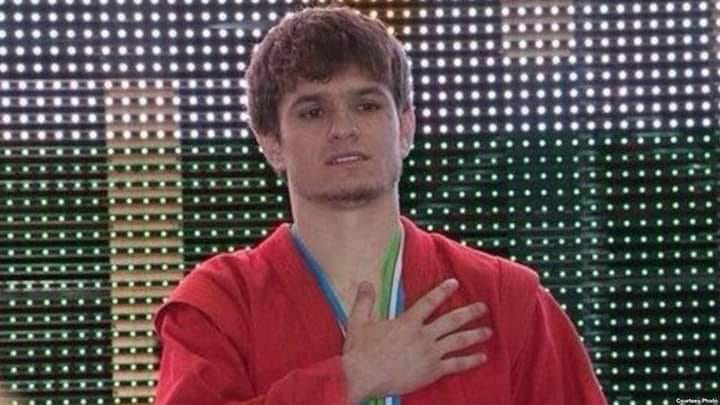
Tajikistan has won one gold and three bronze in the 2018 World Sambo Championships that took place in Bucharest, Romania from November 8 to November 12.
Tajik athlete Khoushqadam Khusravov has won the gold medal for Tajikistan, finishing first in -62kg weight category. In the final he defeated Russian athlete Ruslan Bagdasaryan.
Akmaliddin Karimov (-57kg), Behrouz Khojazoda (-74kg) and Sorbon Larifov (-62kg) grabbed bronze medals for Tajikistan. Sorbon Latifov participated in the combat SAMBO competition.
In all, twelve Tajik athletes participate in the 2018 World Sambo Championships. Eight of them participated in the sports SAMBO among men and four others participated in the combat SAMBO among men.
750 athletes from 80 countries reportedly participated in the 2018 Sambo World Championships in Bucharest.
The athletes competed in 9 weight categories both in sports SAMBO among men and women and in combat SAMBO among men. In total, the athletes competed for 27 sets of medals.
Sambo is a Soviet martial art and combat sport (the word "SAMBO" is an acronym for SAMozashchita Bez Oruzhiya, which literally translates as “self-defense without weapons”). Sambo is relatively modern since its development began in the early 1920s by the Soviet Red Army to improve their hand-to-hand combat abilities. It was intended to be a merger of the most effective techniques of other martial arts.
The pioneers of sambo were Viktor Spiridonov and Vasili Oshchepkov. Oshchepkov died in prison as a result of the Great Purge after being accused of being a Japanese spy. Oshchepkov spent several years living in Japan and training in judo under its founder Jigoro Kano.
Spiridonov and Oshchepkov independently developed two different styles, which eventually cross-pollinated and became what is known as sambo. Compared to Oshchepkov's system, called "Free wrestling" in Russia (known in the West as Catch as Catch Can wrestling or simply Catch wrestling), Spiridonov's style was softer and less brutal. It was also less strength-dependent, which in large part was due to injuries Spiridonov sustained during World War I.
Anatoly Kharlampiyev, a student of Vasili Oshchepkov, is also considered a founder of sambo. In 1938, it was recognized as an official sport by the USSR All-Union Sports Committee.
The World Championships in sports and combat SAMBO have been staged since 1973. The Championship in different years was hosted by Greece, Belarus, the Czech Republic, Bulgaria, Lithuania, Russia and Morocco. This year, the main SAMBO tournament took place once again in Russia.