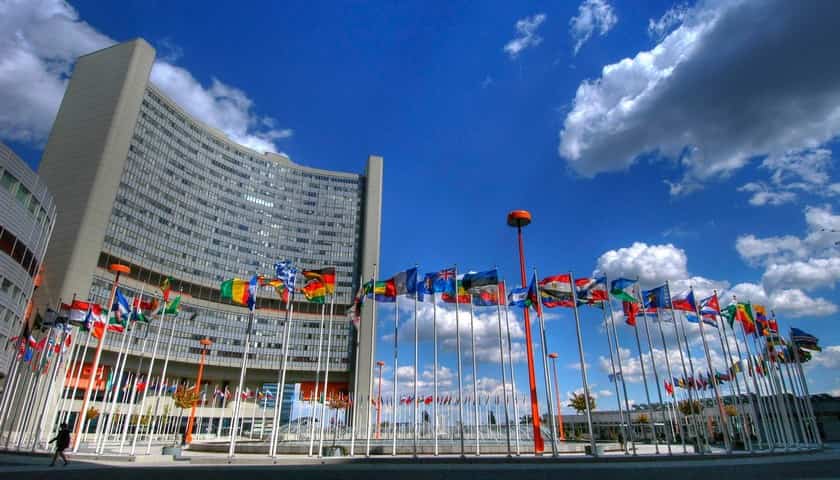
On December 31, 2018, the United Nations General Assembly approved a new scale of assessments for the next three, according to the UN News Center.
For the period of 2019-2021, the maximum assessment rate for the least developed countries (LDCs) is set at 0.011 percent and the maximum assessment rate for rich counties is set at 22 percent.
The greatest share in value reportedly comes from the United States – 22 percent; China – 12.005 percent; Japan – 8.564 percent; Germany – little more than 7.0 percent; France – 4.427 percent; Brazil – 2.9 percent; Canada – 2.734 percent; Russia – 2.405 percent, Australia – 2.21 percent; Kazakhstan – 0.187 percent; Lithuania – 0071 percent, Ukraine – 0.057 percent; Belarus and Azerbaijan – 0.049 percent each; Latvia – 0.047 percent; Estonia – 0.039 percent; Turkmenistan – 0.33 percent; Uzbekistan – 0.032 percent; Georgia – 0.008 percent; Armenia – 0.007 percent; Tajikistan – 0.004 percent; Kyrgyzstan – 0.002 percent.
The term ‘UN scale of assessments’ is used for the amount of money that the General Assembly determines should be assessed to finance the approved appropriation, which is shared among Member States to pay for the expenses of the Organization.
The scale of assessments, when once fixed by the General Assembly, shall not be subject to a general revision for at least three years unless it is clear that there have been substantial changes in relative capacity to pay.
The budget covers UN activities across a range of areas, including political affairs, international justice and law, regional cooperation for development, human rights and humanitarian affairs, and public information.
LDCs benefit from certain caps, discounts or other favorable conditions regarding their contributions to the budgets of United Nations System entities. There are two main methods for determining each Member States’ contributions to these budgets, and the LDC-specific benefits are determined accordingly:
1) Most of the United Nations system budgets are based on the scale of assessments (i.e. the percentages of the budget that each country is responsible for) used for the United Nations regular budget. The scale is determined based on capacity to pay, translated into indicators of gross national income, debt-burden, and per capita income, among others. Each Member State is assigned a percentage (the assessment rate), corresponding to the share of the regular budget its contribution will amount to.
2) Certain agencies use a system based on classes of contributions, whereby countries belong to a class corresponding to a certain share or multiple shares of a pre-determined unit of contribution. LDCs are entitled to contribute at the lowest rates.