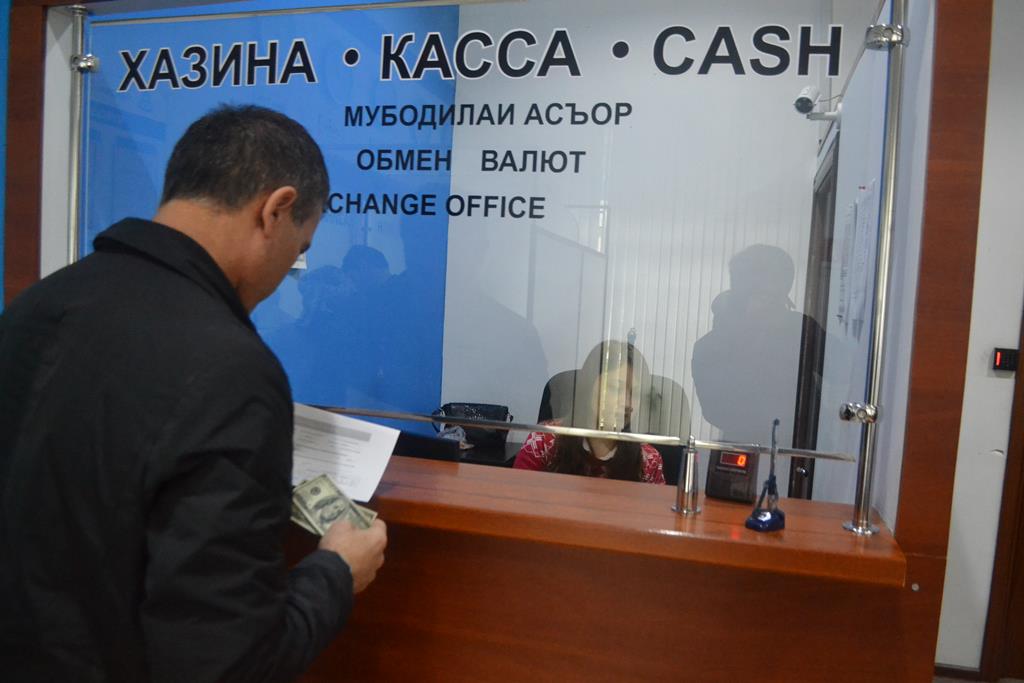
Currency-exchange points of some local banks have stopped selling U.S. dollars because of lack of the U.S. currency. Shortage of dollars in circulation in Tajikistan has led to devaluation of the national currency, the somoni.
Tajik currency market is currently experiencing an acute shortage of U.S. dollars. Some local banks reportedly had no dollars to speak of, while some other lenders like The First Microfinance Bank of Tajikistan, Spitamen Bank and Kazkommertsbank’s Branch in Dushanbe have small amounts (not more than 200.00 U.S. dollars) to go around. Moreover, one person can receive this amount only once in two weeks.
Banks say they could replenish their dollar reserves due to labor migrants’ remittances. “Since 2016, remittances made in Russian rubles are given out only in somonis and we could exchange those Russian rubles for U.S. dollars, but we cannot do so because we must send the received Russian rubles to the National Bank of Tajikistan,” head of one of currency-exchange points told Asia-Plus on the basis of anonymity.
The black market, which has come under intensified scrutiny in the past couple of years, is currently trading the US currency at around 8.80 somoni, while the current average buying rate (the buying rate is the rate at which money dealers will buy foreign currency) of the dollar against the somoni set by the currency-exchange points is 1:9.45.
The somoni (TJS) lost 6.9 percent of its value against the dollar (USD) in a year to December 31, 2018.
An official USD/TJS exchange rate set by the National Bank of Tajikistan (NBT) increased from 1:8.8190 on January 1, 2018 to 1:9.4296 on December 31, 2018.
The current official exchange rate of the dollar against the somoni set by the National Bank of Tajikistan is 1:9.4318
The NBT analysts have attributed the fall in the exchange rate of TJS against USD to negative balance of the country's foreign trade turnover (more than 1 billion USD), expansion of production and commercial activities, increase in currency expenditures on construction of strategic facilities as well as impact of seasonal factors.
Tajikistan has mainly resorted to “administrative resources” to keep the currency on an even keel.
In December 2015, the National Bank ordered the closure of all unauthorized currency exchange points in the city. After that, only banks were able to perform foreign exchange operations. Anybody found violating this new arrangement could face jail terms of up to nine years. Also, banks are forbidden by law from selling somoni at more than 1.5 percent the rate established by the National Bank.
Meanwhile, the Tajik authorities consider that in 2019 the Tajik national currency will lose not more than 3.0 percent of its value against the dollar. According to their forecasts, the somoni is projected to slide to 9.7 somoni to the dollar this year.