Two Stanford University engineering undergraduate students, Faith Harron and Allison Armstrong, were teaching a Makerspace curriculum while spending their summer in Khorog, a town of 30,000 people, nestled in the Pamir mountains.
They taught the Makerspace curriculum at the Aga Khan Lycée, an Aga Khan Education Service (AKES) school.
A Makerspace is a collaborative work space inside a school or other facility to provide creative ways to encourage students to design, experiment, build, and invent, as they engage in science, engineering, art, and other creative projects.
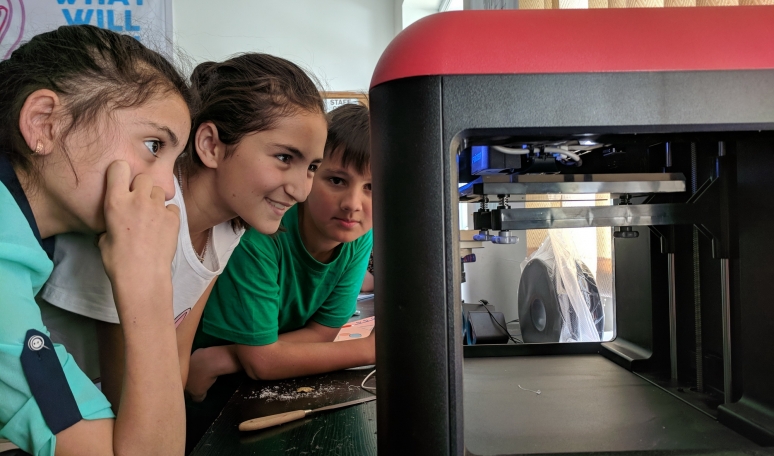
According to the Aga Khan Development Network (AKDN), this nine-week program provided an opportunity to engage 41 Grade 5 students in creative, higher-order problem-solving through hands-on design, construction, and iteration. They reportedly experimented with new technologies and equipment, whilst also contributing towards their interdisciplinary understanding of Science, Technology, Engineering, Art, and Mathematics (STEAM).
Students engaged in weekly projects, including working with paper circuits, bots, light paintings, animation and movies, virtual reality, and 3D printing. They also built roller coasters using the concept of gravity and calculated the velocity of a ball as it traveled over the track, created solar powered ovens to melt cheese, and built their own battery-powered fans.
Every Friday, after a week of more structured classes, students engaged in an optional session called "Open Make," where they could assemble whatever they wanted with the materials available.
During the final week, students worked on self-directed projects that would positively impact their communities using the ideas they learned, and then presented their efforts at an exhibition for families and the community in Khorog.
Growing up in the small town of Bismarck, North Dakota, Faith said she did not have the opportunity to explore her STEAM interests, but since coming to Stanford she has been encouraging her friends and others to "to dream higher." She added: "That’s one of the things most important for a student, to have people that believe in and support them in their dreams, and that’s what I wanted to do with this program in Khorog. A Makerspace like this one is so important for the community here."
Having completed the Cardinal Quarter Fellowship program, a part of Stanford's Haas Center for Public Affairs, Faith and Allison were selected to implement the Makerspace initiative, co-sponsored by the Aga Khan Education Service (AKES) in Tajikistan, and the Aga Khan Lycée.
This initiative stems from the Agreement of Cooperation between the Ismaili Imamat and the State of California, signed in 2009. The Agreement calls for collaboration in a range of fields, including partnerships in the field of education. Partnerships through faculty and student exchanges, teaching, curriculum development, research, capacity building, technical assistance, and continuing education programs, among others, are envisioned as a result of the Agreement.
This is the first such program that has been launched in Tajikistan, and from the reaction and feedback of students, parents, and the Aga Khan Lycée, has been a tremendous success.
“The learning from this will be incredibly vital to us continuing this program as an after-school program during the upcoming academic year, and its expansion for the following summer and beyond to other Aga Khan Education Service units,” said Aziz Batada, AKES (Tajikistan and Kyrgyzstan Regional Head of Education).
The Aga Khan Lycée, Khorog is a school that was established in September 1998. Tajik President Emomali Rahmon inaugurated the school with His Highness the Aga Khan.
The Lycée, part of the Aga Khan Education Services (AKES), is built on the premises of the former School #3 (named after Kirov), a school with a distinguished history in the Gorno Badakhshan Autonomous Region (GBAO). The majority of students are from Badakhshan, Tajikistan with some from other countries.
The Aga Khan Schools strive to create a harmonious balance between academic demands, sporting and cultural activities and community life. It challenges its pupils to be intellectually inquisitive and socially conscious. The Lycée believes that while what students know is important, the true measure of a student’s education is the ability to analyze what they do not know.