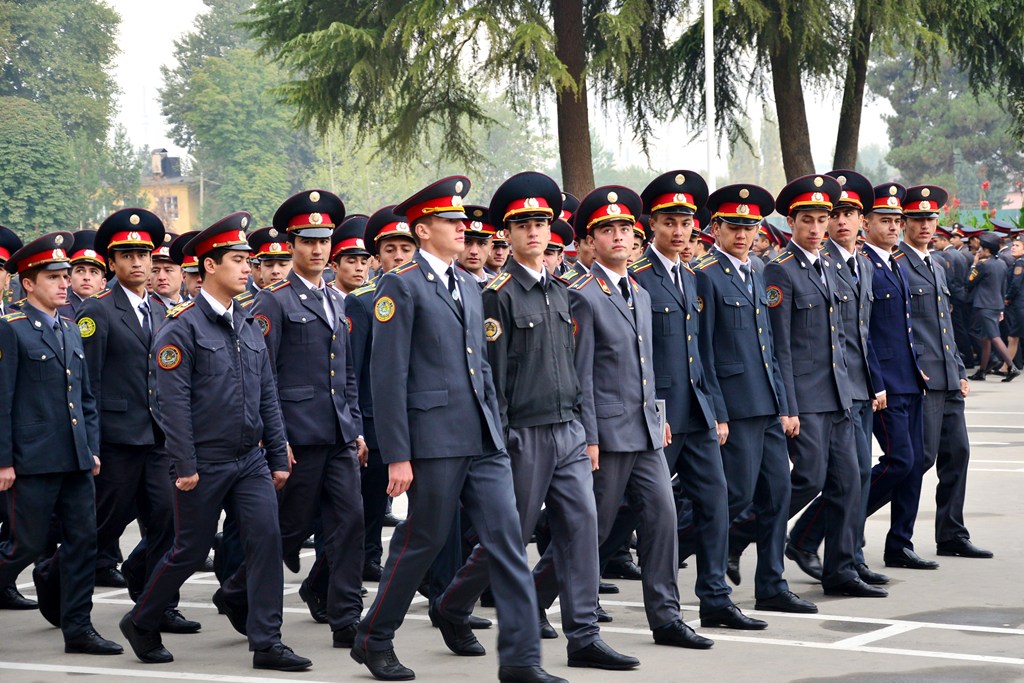
Budgetary funds are not enough and Tajik authorities have decided to borrow money for renaming the country’s police force from international community.
A meeting of the working group on the police reform will take place at the National Library of Tajikistan in Dushanbe on March 12.
Representatives of the OSCE, the European Union, UNDP, the UN Office on Drugs and Crime (UNODC) as well as diplomatic missions of the United States, Russia, Germany, France, the united Kingdom, China, Japan, Turkey, Saudi Arabia and Qatar and some international organizations active in the country to attend the meeting, an official source at the Interior Ministry of Tajikistan told Asia-Plus in an interview.
According to him, the main issue of the meeting’s agenda will be seeking donors for renaming the country’s police force.
“Funds provided by the country’s budget for renaming police force and producing new uniform for law enforcement officers are not enough and donor are expected to provide funds for these purposes,” the source said.
The renaming, under which the country's police force will formally be referred to as “politsia” instead of the Soviet-era “militsia,” is part of what the police reform.
Tajik police reform is a reform aimed at improving the efficiency of Tajikistan’s police force.
The Police Reform Strategy in Tajikistan (Strategy) is a document, which defines the state policy on combating crime. It reflects the actions that will be implemented by the Government of Tajikistan in a mid-term on police reforming and development of Tajikistan.
The Strategy has been developed by national experts in cooperation with the Organization for Security and Cooperation in Europe (OSCE) Office in Tajikistan based on the Joint Needs Assessment of the Ministry of Internal Affairs (MIA) of Tajikistan, carried out by the OSCE assessment team in 2008, as well as based on the “Police Reform Assessment” workshop, conducted from November 9 to 20, 2009.
The Strategy is aimed at the identification of goals, priorities and measures on Police Reforming and Development, the implementation of which facilitates the solution of crucial tasks of socio-economic development of Tajikistan in the modern era.
The Strategy represents a completely new approach to developing of internal affairs agencies of Tajikistan, taking into consideration the world practice on development and implementation of similar strategic documents, lessons and conclusions of past phases of Police Development, as well as the current realities and perspectives of its development.
The Strategy is implemented in accordance with the Program (Strategy) of Police Development Perspectives, with the participation of the following stakeholders: the Government of the Republic of Tajikistan, internal affairs agencies, civil society institutes, the population of Tajikistan, and international organizations with donor-states.
The Strategy takes into account and envisages the reforms, occurring in the key areas of the society and the state vital activity.