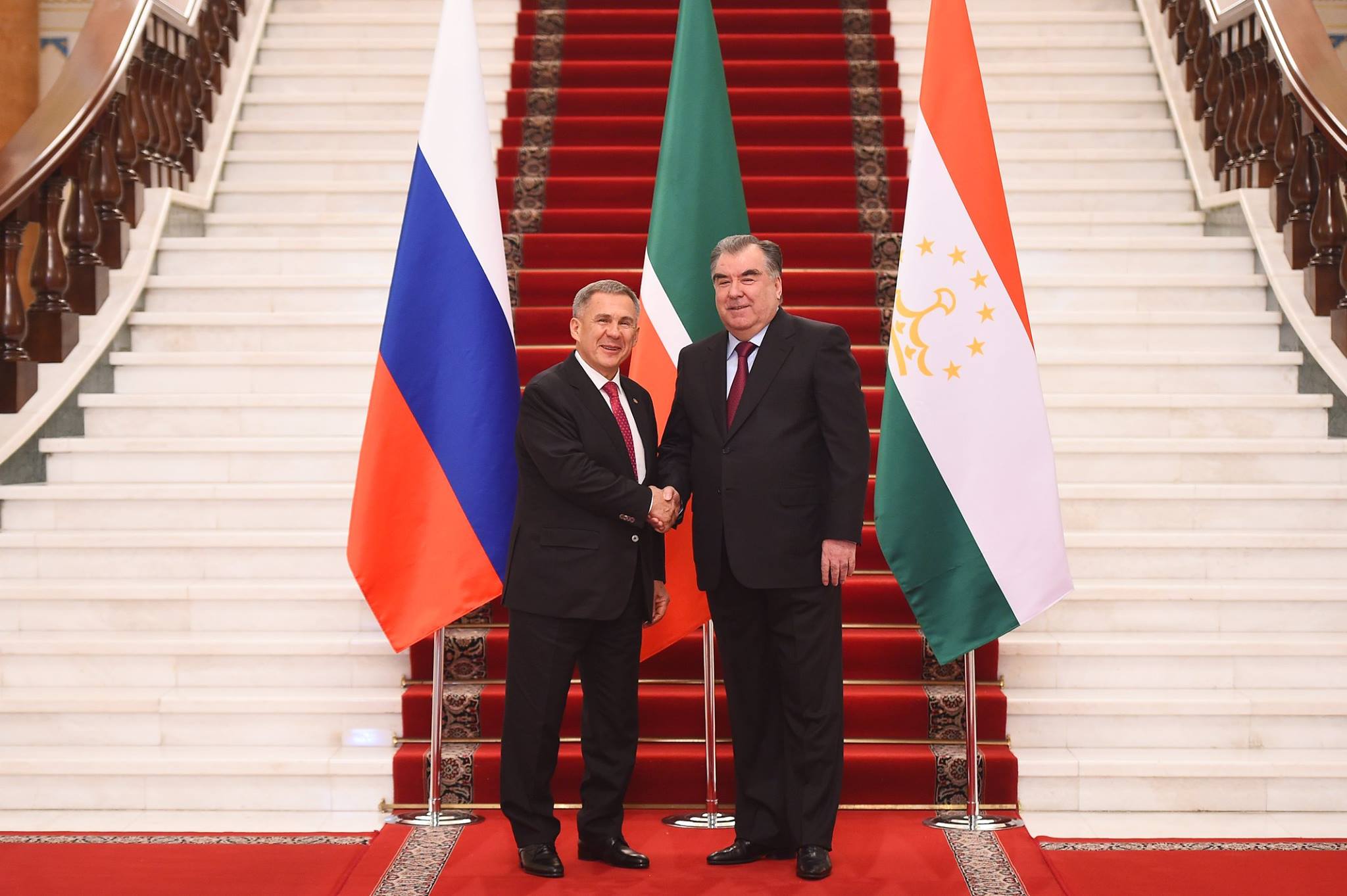
President Emomali Rahmon yesterday received visiting President of Russia’s Tatarstan Republic, Rustam Minnikhanov, who arrived in Tajikistan on a working visit.
Rahmon and Minnikhanov positively assessed the bilateral cooperation between Tajikistan and the Russian Federation, according to the Tajik president’s official website.
At the same time, they reportedly noted that there was considerable room for expansion of economic ties.
Rahmon and Minnikhanov outlined sectors like industry, transport, agriculture and pharmaceutics as areas which could drive the bilateral trade between Tajikistan and the Republic of Tatarstan, the Tajik president’s website says.
They reportedly also underlined the necessity of using opportunities of Tajikistan’s fee economic zones, creating and developing technological parks in Tajikistan, establishing joint labor exchanges and training high-quality personnel for Tajikistan’s economic sectors for further expansion of bilateral economic cooperation.
The Republic of Tatarstan, or simply Tatarstan, is a federal subject (a republic) of the Russian Federation, located in the Volga Federal District. Its capital is the city of Kazan. The unofficial Tatarstan motto is Bez Buldırabız! (We can!).
Tatarstan is one of the most economically developed regions of Russia. The republic is highly industrialized and ranks second to Samara Oblast in terms of industrial production per square kilometer. The region's main source of wealth is oil. Tatarstan produces 32 million tons of crude oil per year and has estimated oil reserves of more than 1 billion tons. Industrial production constitutes 45% of the republic's gross regional domestic product. The most developed manufacturing industries are petrochemical industry and machine building. The truck-maker KamAZ is the region's largest enterprise and employs about one-fifth of Tatarstan's workforce. Kazanorgsintez, based in Kazan, is one of Russia's largest chemical companies. Tatarstan's aviation industry produces Tu-214 passenger airplanes and helicopters. The Kazan Helicopter Plant is one of the largest helicopter manufacturers in the world. Engineering, textiles, clothing, wood processing, and food industries are also of key significance in Tatarstan.