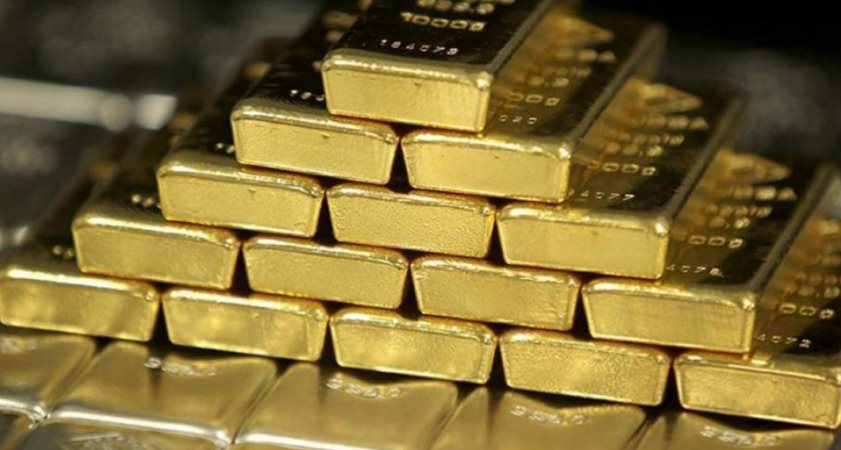
A report released by the World Gold Council (WGC) on May 2, in particular, notes that central banks of Uzbekistan, Mongolia and Tajikistan were the largest sellers of gold in the first quarter of this year.
Over the report period, the central bank of Uzbekistan has reportedly sold 6.2 tons of gold and Mongolia’s central bank has sold 3.4 tons f of gold over the same three-month period.
Tajikistan’s central bank has reportedly sold one ton of gold in January-March this year.
Meanwhile, Russia’s central bank was leader on purchasing gold over the first three months of this year.
According to the report, Russia’s central bank has purchased 55.3 tons of gold in January-March this year, bringing its gold reserves to 2,168.3 tons.
The report authors link this trend to Russia’s striving for reducing dependence on the U.S. dollar in the event if new sanctions are imposed.
As of January 1, 2019, Tajikistan’s gold-and-currency reserves are equivalent to 4.9 months of import cover.
Last year, an average monthly volume of Tajikistan’s imports amounted to little more than 262 million U.S. dollars.
According to the National Bank of Tajikistan (NBT), Tajikistan’s international reserves have risen 2.4 times over the past four years.
Tajikistan produced a record amount of gold in 2018 – more than 6.4 tons.
According to the Ministry of Industry and New Technologies (MoINT), Tajikistan last year produced gold 16.9 percent more than in 2017. The ministry refrains from disclosing the actual amount of gold produced in the country last year.
Meanwhile, the then Minister of Industry and New Technologies, Shavkat Bobozoda, told reporters in Dushanbe on February 13 last year that Tajikistan produced 5,500 kilograms in 2017, which was 11.2 percent more than in 2016. Bobozoda noted that it is planned to increase gold production in 2018 by 20 percent compared to 2017.
“Over the last four years, an average annual gold production growth rate has amounted to more than 20 percent,” Bobozoda added.
Proceeding from the fact that Tajikistan produced 5.5 tons of gold in 2017, one can calculate that more than 6.4 tons of gold were produced in the country last year.
Tajikistan has 137 deposits with estimated reserves of industrial gold and 127 deposits of non-industrial gold. Tajikistan plans to increase annual production of gold to 17 tons beginning on 2022.
Four large gold mining companies now operate in Tajikistan: Tilloi Tojik; Tajik-Chinese JV Zarafshon; Tajik-Canadian JV Aprelevka; and China Nonferrous Gold Limited, which is the first foreign company to obtain 100% ownership of a mining and exploration project in Tajikistan. Besides, enterprises such as Odina, Nazira, Ganj, Barakat and Istiqlol are engaged in gold production in the country.
Most of gold comes from the Jilau deposit operated by Tajik-Chinese joint venture, Zarafshon, which reportedly accounts for more than 70 percent of the total amount of gold produced in Tajikistan.