



The World bank will support Tajikistan in achieving sustained economic growth, boosting exports, and creating more and better jobs for its citizens, through enhanced private-sector development and greater investment in human capital and public services.
The World Bank Group’s Board of Executive Directors endorsed its new Country Partnership Framework for Tajikistan 2019-2023 on May 5.
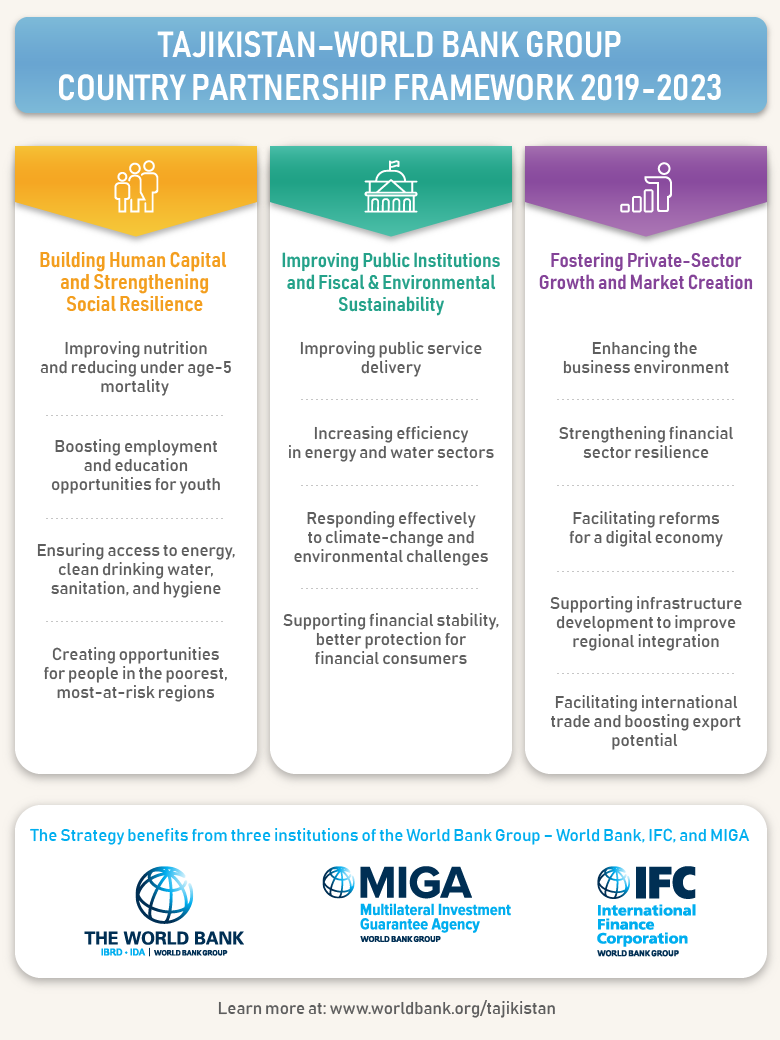
The Country Partnership Framework supports Tajikistan’s efforts to complement its remittance-financed, import-reliant economic model with a focus on boosting private-sector development and exports. Tajikistan has an opportunity to reconnect to the legacy of the ancient Silk Road and capitalize on its resources, including abundant water and hydro-energy supplies, agriculture and food processing, minerals, and tourism. By improving the business environment and confidence among enterprises, Tajikistan can encourage private investments which would create greater opportunities for its young and growing population, according to press release issued by the World Bank.
“Tajikistan has a window of opportunity to start transitioning toward becoming a continental energy and trade hub, with access to huge markets in South, East and Central Asia. This could help the country build the foundation of a modern economy that can generate wealth and employment to benefit all of its citizens,” said Jan-Peter Olters, World Bank Country Manager for Tajikistan.
He further noted that at this stage of Tajikistan’s development, the country needs to expand contributions from a viable private sector, effective public institutions, and a healthy and productive population to reach its development goals in a changing global environment.
“The new Country Partnership Framework will provide support in these critical areas,” the World Bank country manager said.
The five-year Country Partnership Framework will benefit from the three institutions of the World Bank Group—the World Bank, the International Finance Corporation (IFC), and the Multilateral Investment Guarantee Agency (MIGA)—and will be implemented in close coordination with local and international development partners.
The new strategy was prepared in close collaboration with the Government of Tajikistan and involved consultations with the private sector, civil society, academia, local experts, and development partners. It drew from critical analytical work, such as the Systematic Country Diagnostic, the Country Economic Memorandum, the Risk and Resilience Assessment Report, the Job Diagnostic and Strategy for Tajikistan, and other studies and reports. It is closely aligned with the goals of the 2030 National Development Strategy.






