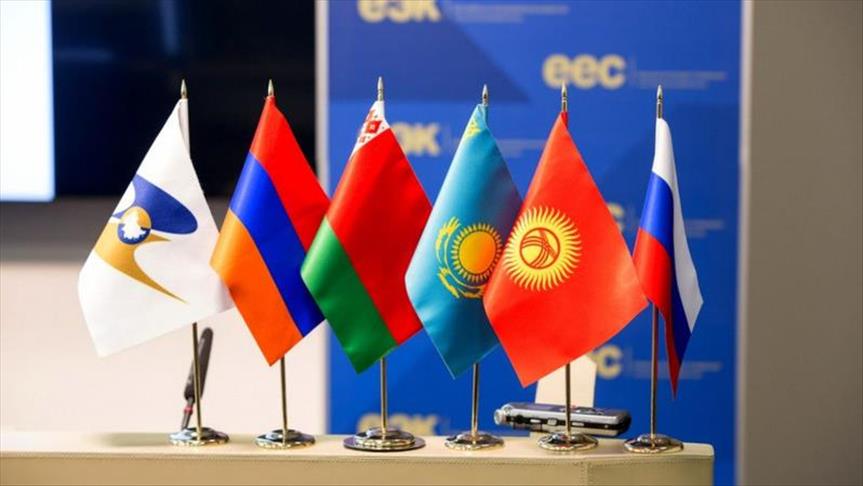
Tajik President Emomali Rahmon will attend the Eurasian Economic Union (EAEU) summit in Kazakhstan’s capital, Nur-Sultan, as guest of honor.
Dedicated to the 25th anniversary of Nursultan Nazarbayev’s idea of Eurasian integration and the fifth anniversary of the Eurasian Economic Union, the summit will take place in Nur-Sultan on May 29, according to the Kazakh president’s press service.
First President of Kazakhstan Nursultan Nazarbayev, President of Belarus Alexander Lukashenko, President of Kazakhstan Kassym-Jomart Tokayev, President of Kyrgyzstan Sooronbai Jeenbekov, President of Russia Vladimir Putin, Prime Minister of Armenia Nikol Pashinyan will partake in the event.
President of Moldova Igor Dodon has been invited as observer and President of Tajikistan Emomali Rahmon has been invited as guest of honor.
The summit will take place in the narrow and external formats.
The meeting will focus on relevant aspects and prospects of development of the Eurasian Economic Union, including implementation of the digital agenda and key areas of work of the Union, and macroeconomic policy for 2019-2020.
The heads of state will also discuss issues related to expansion of international cooperation within the EAEU, formation of the common electricity market within the EAEU, and customs cooperation.
The Eurasian Economic Union (EAEU) is an economic union of states located primarily in northern Eurasia. A treaty aiming for the establishment of the EAEU was signed on May 29, 2014 by the leaders of Belarus, Kazakhstan and Russia, and came into force on January 1, 2015. Treaties aiming for Armenia’s and Kyrgyzstan’s accession to the Eurasian Economic Union were signed on October 9 and December 23, 2014, respectively. Armenia’s accession treaty came into force on January 2, 2015. Kyrgyzstan’s accession treaty came into effect on August 6, 2015.
The Eurasian Economic Union has an integrated single market of 183 million people and a gross domestic product of over 4 trillion U.S. dollars (PPP). The EAEU introduces the free movement of goods, capital, services and people and provides for common transport, agriculture and energy policies, with provisions for a single currency and greater integration in the future. The union operates through supranational and intergovernmental institutions. The Supreme Eurasian Economic Council is the “Supreme Body” of the Union, consisting of the Heads of the Member States. The other supranational institutions are the Eurasian Commission (the executive body), the Eurasian Intergovernmental Council (consisting of the Prime Ministers of member states) and the Court of the EAEU (the judicial body).