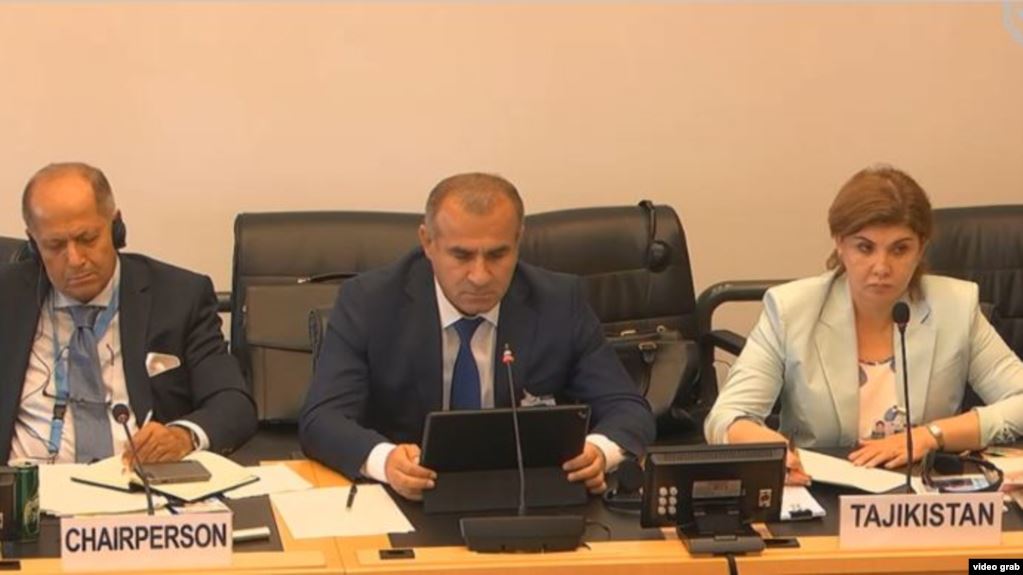
The UN Human Rights Committee is reviewing the situation for human right in Tajikistan.
The discussion of the report of the Government of Tajikistan on the respect for human rights in the country and implementation by Tajikistan of the International Covenant on Civil and Political Rights (ICCPR) is going on today at a session of the UN Human Rights Committee in Geneva.
Headed by Tajik chief prosecutor Yusuf Rahmon, the Tajikistan delegation arrived in Geneva to present the report.
The delegation members include Abdujabbor Sattorzoda, the head of the Human Rights Guarantees Department of President’s Executive Office, Umed Bobozoda, Human Rights Ombudsman of Tajikistan, and Shahzoda Nodiri, Deputy Minister of Justice of Tajikistan.
Presenting the report, Tajik chief prosecutor Yusuf Rahmon noted on July 2 that the Government of Tajikistan gives a special attention to fulfillment of its international obligations on providing human rights, according to Radio Liberty’s Tajik Service.
Tajik chief prosecutor reportedly noted that the Tajik authorities are combating torture of prisoner and detainees and state that the relevant structures respect all rights of detainees during interrogations.
Yusuf Rahmon also noted that all rights of believers are respected in Tajikistan.
The Human Rights Committee monitors States parties’ adherence to the International Covenant on Civil and Political Rights, which to date has 172 States parties. The Committee is made up of 18 members who are independent human rights experts drawn from around the world, who serve in their personal capacity and not as representatives of States parties.
The Human Rights Committee is the body of independent experts that monitors implementation of the International Covenant on Civil and Political Rights by its State parties.
All States parties are obliged to submit regular reports to the Committee on how the rights are being implemented. States must report initially one year after acceding to the Covenant and then whenever the Committee requests (usually every four years). The Committee examines each report and addresses its concerns and recommendations to the State party in the form of "concluding observations.”