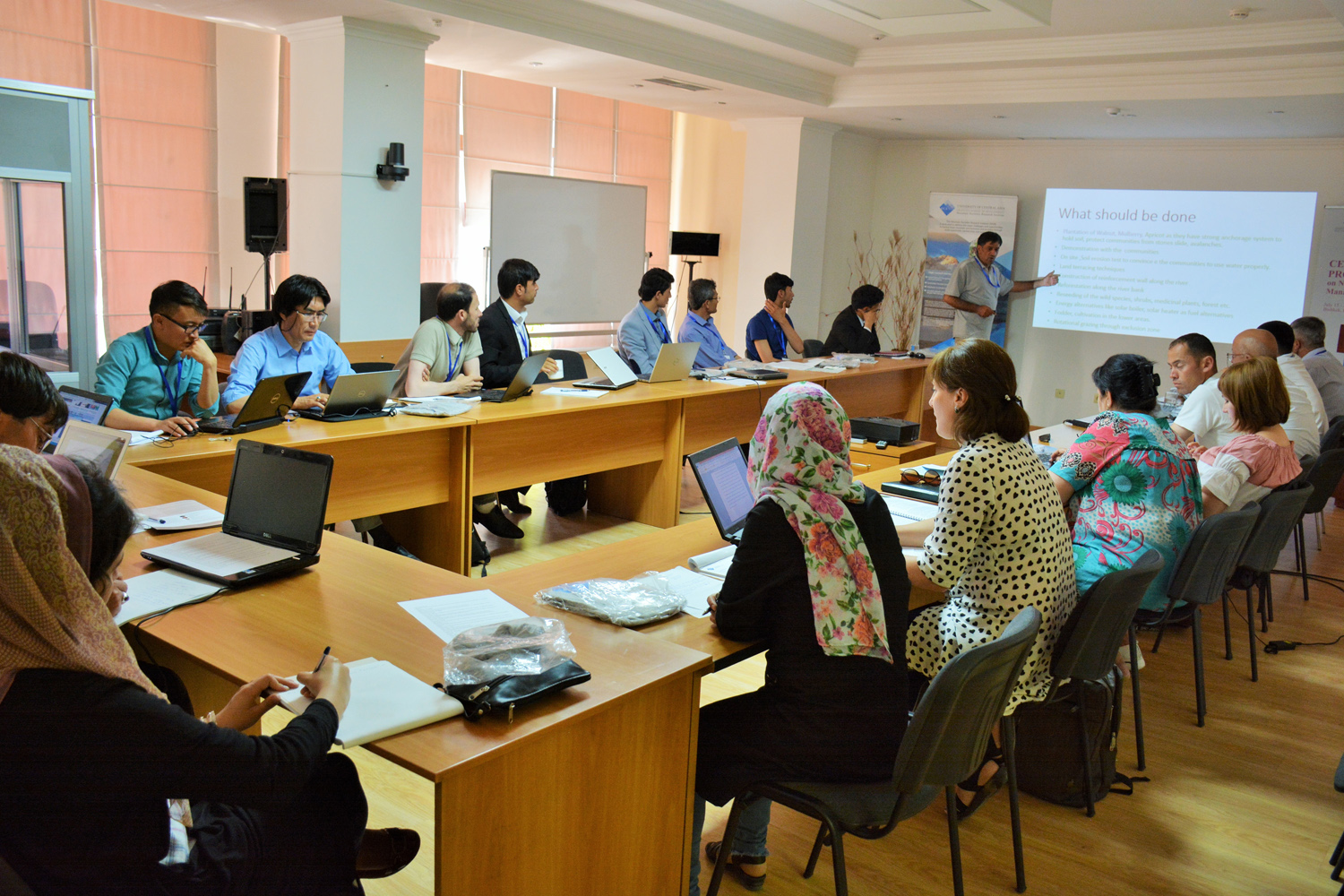
A post-graduate Certificate Program in Natural Resources Management that was launched at the University of Central Asia (UCA) on July 15 has reportedly enrolled 21 participants including faculty members and researchers of Badakhshan University, Bamyan University, Khorog State University and the Aga Khan Foundation (AKF) in Afghanistan.
According to press release issued by UCA, the three-week intensive, 30 ECTS (European Credit Transfer and Accumulation System) program is offered by UCA through its Graduate School of Development’s Mountain Societies Research Institute (MSRI) as part of on-going project ‘Pathways to Innovation: Strengthening Mathematics, Science, and Economic Policy Capacity in Afghanistan and Central Asia’, funded by the International Development Research Centre (IDRC), Canada, and the Aga Khan Foundation Canada.
The course is reportedly designed to deepen university faculty understanding of natural resources management issues in mountain regions that will enhance their research and teaching capabilities
“It is very rewarding that this first teaching program of MSRI has been offered to a group of people who are either academically or through practice concerned with natural resources management,” said Dr. Bohdan Krawchenko, Dean of the Graduate School of Development at UCA. “We hope this is not the first and only educational opportunity, and we plan to continue the tradition of supporting small research projects in the universities of Badakhshan, Bamyan and Khorog.”
The training components and delivery of the program are built on the MSRI’s research work. Five integrated topics have been selected that better describe the most pressing natural resource issues in Afghanistan and in Tajikistan including: concepts of sustainability and sustainable land management; integrated agricultural management and food systems; livelihoods in rural mountain communities; natural hazards and disaster risk reduction; and climate change.
The course will also include field studies and a final research project or paper which will be completed when learners return to their universities. Alongside on-line mentoring provided by MSRI staff, this will help participants apply learnt concepts in a practical way.
The three-year Pathways to Innovation, a multi-faceted project with components implemented by MSRI, the Institute of Public Policy Administration and the School of Professional and Continuing Education, focuses on innovative and applied research and training to strengthen individual and organizational skills in mathematics, environmental science and economic policy capacities in Afghanistan, Tajikistan, and Kyrgyzstan. This focus aligns with the project’s overarching objective of contributing to human and organizational capacity for innovation in Central Asia and Afghanistan.