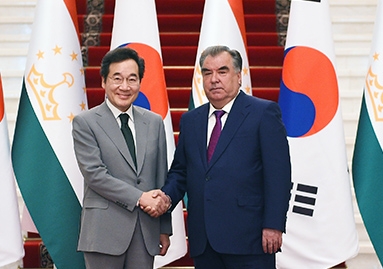
South Korean Prime Minister Lee Nak-yeon, who is currently in Tajikistan on a three-day official visit, yesterday met here with Tajik President Emomali Rahmon.
According to the Tajik president’s official website, the two sides discussed state and prospects of further expansion of bilateral cooperation between Tajikistan and South Korea.
Tajik leader, in particular, noted that expansion of cooperation with South occupies a worthy place in Tajikistan’s foreign policy.
It was noted during the meeting that the Tajik side welcomes opening of the office of the Korea International Cooperation Agency (KOICA) in Dushanbe and is interested in establishing cooperation with other Korea’s organizations.
In the course of the talks, Rahmon and Lee reportedly also exchanged views on issues related to inter-parliamentary cooperation, political and economic cooperation.
They outlined sectors like hydropower, agriculture, industry, tourism, finance and banking, migration, public health, and pharmaceutics as areas that could drive the bilateral trade between Tajikistan and South Korea.
Emomali Rahmon noted that holding of Tajikistan-Korea business forums and a tripartite meeting of representatives of business communities of Tajikistan, Korea and Uzbekistan that took place last year were important measures to boost economic cooperation between the two countries.
After the Republic of Tajikistan gained its independence, the Republic of Korea was among the first countries to recognize Tajikistan. Officially, the diplomatic relations between Tajikistan and South Korea were established on April 27, 1992.
The Embassy of the Republic of Korea in Dushanbe has been operating since June 20, 2008.
The political and trade-economic relations between the two countries are based on agreements in the field of trade, mutual protection and encouragement of investments, rejection of mutual requirements for obtaining visas for holders of official and diplomatic passports.
Tajikistan intends to use the experience of Korea, equipment and new technologies to establish domestic production of household appliances, hygiene products, household chemicals and high-quality competitive light industry products based on local raw materials.