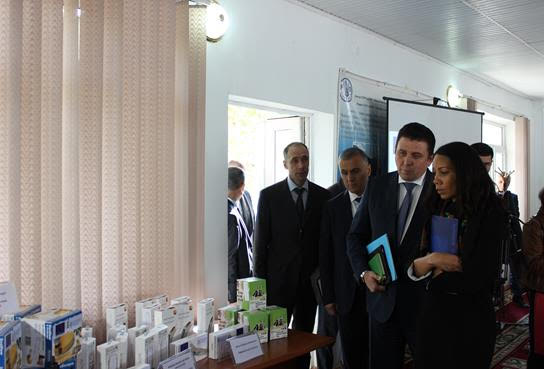
On Tuesday November 12, laboratory equipment to enhance the food quality and safety control system in Tajikistan was handed over by the Food and Agriculture Organization of the United Nations (FAO) to the Committee for the Food Security under the Government of Tajikistan as part of a European Union funded project to strengthen institutions and capacity of the agriculture and veterinary services.
The handover ceremony took place at the National Center for Diagnostics of the Committee in Dushanbe.
According to the European Union Delegation to Tajikistan, this initiative was launched in cooperation with the Food Security Committee under the agricultural reform process to enable Tajikistan advancing food quality and safety control system in the border control laboratories of the country that contributes to better response and preparedness of Tajik authorities in case of emergencies and reduces food safety risks. Items range from express milk and meat analyzers to fluorescence microscope, radiation detector and nitrate tester, infrared distance thermometer, thermo box and egg сandler, and many more.
Food safety and quality continues to grow in importance as more products from a wider range of sources enter the Tajik markets. Laboratory testing is an important process, which relies on analysis to identify problems with food products.
It provides analytical data on the quality of the product or production process to support quality control and food safety. These are aiming to identify contaminants in raw materials or contaminations after products are produced and before they are placed on the markets.
As pointed out by H.E. Marilyn Josefson, European Union Ambassador to Tajikistan: “Hardware and capacity of laboratory staff are not only important to ensure safe food for the consumers in Tajikistan, but will also support Tajik producers match food safety requirements for example to export to the European market. We welcome more Tajik products in Europe and the provision of laboratory equipment is an important step in the right direction. Boosting exports will increase economic growth and improve the livelihoods of rural population in Tajikistan”.
“It is important step of our support to the Committee for the Food Security from the EU-funded project. Food quality control and safety are of global concerns. Due to globalization and international trade, imported, exported and transit shipments of products are very vital. For this reason, it is imperative that effective surveillance, early detection and response capacities are in place in order to avert potential public health risks and economic impacts,” stated Oleg Guchgeldiyev, FAO Representative in Tajikistan.
This activity is in support of the government’s efforts to build the diagnostic capacity of national laboratories across the country to detect and report about.
By rolling out of this project FAO and EU are anticipating a significant improvement of the food quality and safety control system in Tajikistan that will enhance food security, secure livelihoods and increased household incomes of livestock producers and protect public health.