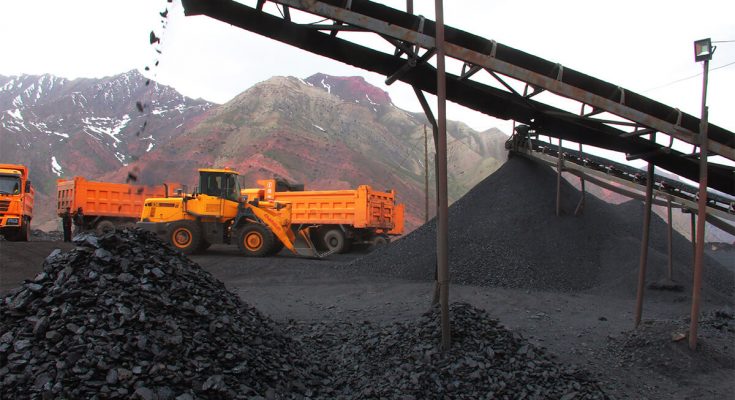
Tajik coal-mining enterprises produced more than 2 million tons of coal last year, which is 121,000 tons more than in 2018, according to the Ministry of Industry and New Technologies (MoINT).
“It is the largest amount of coal ever produced in Tajikistan,” an official source at a MoINT told Asia-Plus in an interview.
According to him, only 11 of 18 coal-producing enterprises operated last year. Seven others were not in operation due to the expiration of their operating licenses.
Fon Yaghnob Mine, TALCO-Resource Ltd, KMT Ltd, ZIddi and Open Joint-Stock Company (OJSC) Angisht reportedly accounted for about 97 percent of a total volume of this type of fossil fuel produced in 2019.
The Dushanbe-2 combined heat and power (CHP) plant is reportedly the main consumer of Tajik coal – more than 50 percent of total sales. It is followed by industrial enterprises (31 percent), residential consumers (13 percent) and federally funded institutions (3.0 percent).
Last year, Tajikistan exported about 18,000 tons of coal to Pakistan and Uzbekistan, which is only 0.9 percent of a total volume of coal production in 2019.
This year, Tajikistan plans to increase coal production due to expanding underground coal mining. . To-date, Tajikistan has used mostly a surface mining technique of extracting coal (open-pit, open-cast or open cut mining).
Last year, underground mining reportedly accounted for only 5.5 percent of a total volume of coal production in Tajikistan.
Over the past four years, cola production in Tajikistan has increased nearly 2.3 times – from 870,000 tons in 2014 to 2 million tons in 2019.
Exploration and development of coal fields has been intensified in Tajikistan since 2012 when Uzbekistan stopped gas shipments to Tajikistan.
In 2014, coal production amounted to 870,000 tons, in 2015 – already 1 million tons. In 2016, the volume of coal production in Tajikistan increased by another 30% reaching nearly 1.4 million tons. In 2017, Tajikistan produced more than 1.7 million tons of coal.
Coal deposits of Tajikistan are reportedly concentrated in two coal basins: Tajik (Gissar-Darvaz) and Fergana. The first of them covers the absolute majority of deposits and occurrences concentrated in central and southern Tajikistan. Deposits and occurrences of northern Tajikistan belong to the South Fergana coal basin.
The coal deposits of the Tajik coal basin in the vast majority of cases are exposed in the mountain ranges of the Tien Shan and Pamir-Alay, framing the Afghan-Tajik basin.
The industrial potential of the Tajik coal basin is significant. According to experts from the Eurasian Development Bank (EDB), Tajikistan’s possible coal reserves are estimated at least 4.3 billion tons.
On the territory of Tajikistan there are four regions of development of carbonaceous deposits, each one has a number of characteristic features according to geological zoning: 1) Zarafshan-Gissar; 2) South Gissar; 3) the Pamir Darvaz; and 4) south-Fergana.
The biggest region, largest in acreage coal-bearing area that has the maximum number of coal veins, is Zarafshan-Gissar. The coal-bearing strata extend in almost uninterrupted strip from Panjakent to the river head of the Zarafshan River.