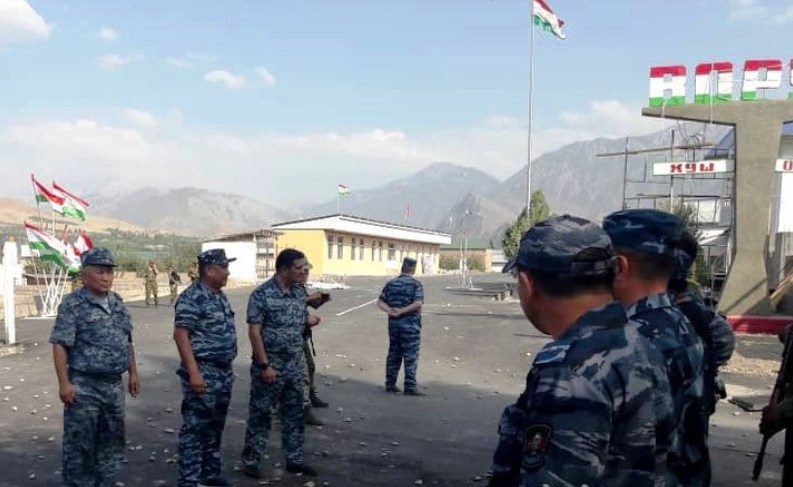
Dushanbe and Bishkek have begun discussing the land exchange issue. Tajik authorities hope that the border delimitation issue has got off the ground.
Tajikistan and Kyrgyzstan have discussed possible land exchanges to resolve long-festering border disputes.
Recall, Tajik and Kyrgyz officials held talks on border issues on January 14 following another round of clashes between Kyrgyz and Tajiks residing close to a disputed segment of the two countries’ share border. The two sides reportedly agreed to start the process of a land swap along a disputed segment of the mutual border.
The talks were held at a border checkpoint near the Tajik village of Guliston and the Kyrgyz village of Kyzyl-Bel in the southern Batken region.
Tajik Deputy Prime Minister Azim Ibrohim led the Tajik delegation at the talks and the Kyrgyz delegation was led Deputy Prime Minister Jenish Razakov.
The sides reportedly signed a joint protocol, according to which a joint working group by February 15 will attempt to agree on the line of demarcation of the 114-kilometer border segment. On March 1, they aim to define areas equal by size and significance for exchange.
The latest incident along the Tajik-Kyrgyz border took place on the night of January 9-10. As usual, both sides blamed each other for the incident
Meanwhile, a source closed to the negotiating process says the working groups of the two countries on delimitation of the disputed segments of the border are meeting in Bishkek today.
“The experts will discuss the issue of exchanging land plots in the villages of Ak-Sai and Samarkandek that are located in border areas between Tajikistan’s Isfara and Kyrgyzstan’s Batken,” the source noted.
According to him, the border delimitation issue got off the ground after a phone conversation between Tajik President Emomali Rahmon and His Kyrgyz counterpart Sooronbay Jeenbekov that took place on January 13.
It is to be noted that Tajikistan and Kyrgyzstan have not yet resolved the border delineation problem. Many border areas in Central Asia have been disputed since the collapse of the Soviet Union in 1991. The situation is particularly complicated near the numerous exclaves in the Ferghana Valley, where the borders of Tajikistan, Uzbekistan, and Kyrgyzstan meet.
The border of Kyrgyzstan and Tajikistan has been the scene of unrest repeatedly since the collapse of the former Soviet Union. The countries share 971 kilometers of border – of which only 504 kilometers has reportedly been properly delineated.
Last year alone, there were at least fourteen cases of violence, in which six Tajik nationals and one Kyrgyz citizen were killed and more than 60 other people were injured.