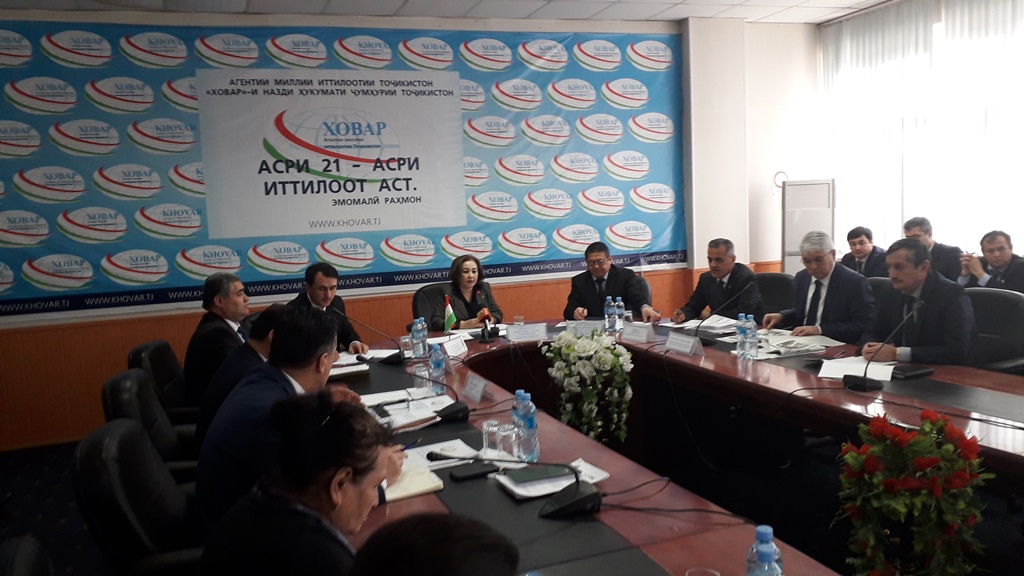
In a report released at a news conference in Dushanbe, representatives of the Ministry of Labor, Migration and Employment of the Population revealed on February 7 that an average monthly wage last year rose 9 percent compare to 2018 and amounted to 1,323.9 somoni.
In the real sector of the economy, the highest average monthly wage was reported in the mining sector – 2,577 somoni. In the construction sector, an average monthly wage last year amounted to 2,395 somoni. In the energy and water supply sector, an average monthly wage last year amounted to 2,002 somoni.
In the service sphere, the highest monthly wage last year was reported in the financial and insurance sectors – 3,330 somoni. In the communications and information sector, an average monthly wage last year amounted to 2,548 somoni.
Last year, the minimum wage in Tajikistan amounted to 400.00 somoni (equivalent to 41.00 U.S. dollars).
Meanwhile, wage debts last year rose 92 percent in Tajikistan compared to 2018. As of January 1, 2020, total wage debts reportedly amounted to more than 50 million somoni.
In the territorial cross section the highest wage debts were reported in the districts subordinate to the center — 16.3 million somoni or 32.4 percent of the total wage debts, Sughd province – 15.2 million somoni or 30.2 percent, and Dushanbe – 11.8 million somoni or 23.5 percent.
Last year, the highest wage debts were reported in the mining sector – 19.8 million somoni or 39.5 percent of the total wage debts, and in the construction sector – 12.8 million somoni or 25.4 percent.
The most incorrigible nonpayers are mainly extrabudgetary enterprises and organizations: Tajik national air carrier Tajik Air – 11.8 million somoni; Adrasman Ore Refinery – 10.3 million somoni; Roghun HPP – more than 6.9 million somoni; Sokhtmoni Asosi (construction company) – 3.1 million somoni; JSC Tamokhush (chemical plant) – more than 25 million somoni, TojikAzot (fertilizer factory) – 2.5 million somoni; TALCO Chemical – more than 1.6 million somoni; and so forth.
According to data from the CIS Interstate Statistical Committee Meanwhile, Tajikistan last year had the lowest wages among CIS countries.