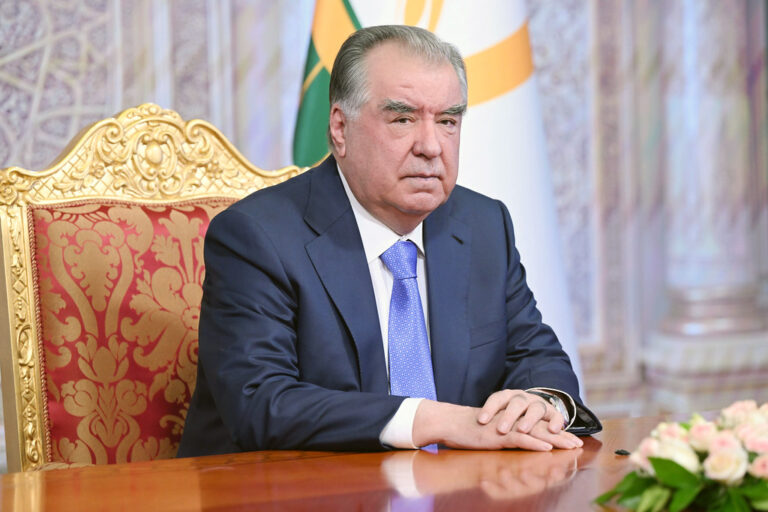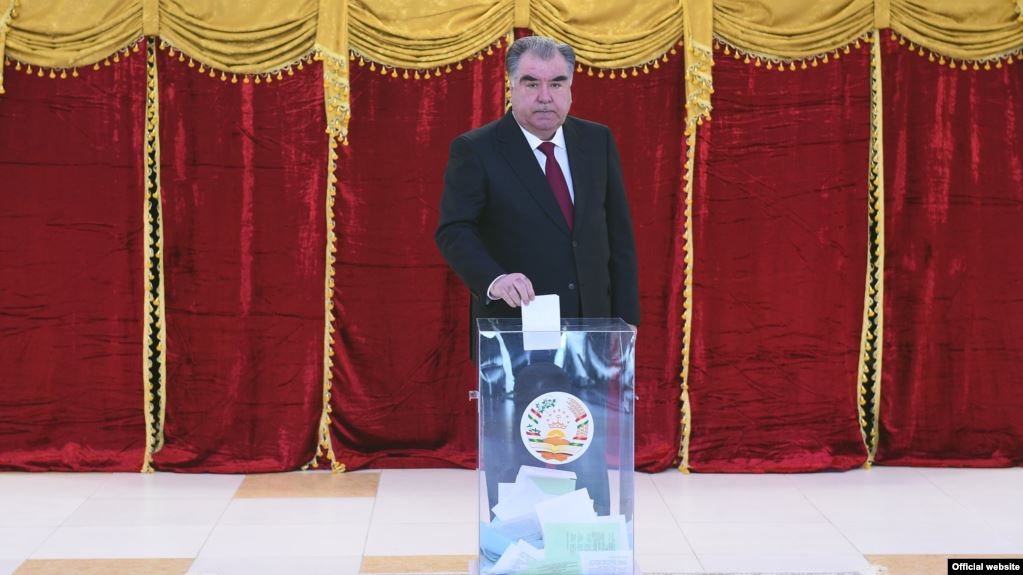
Tajiks voted in parliamentary elections on March, 1 in which President Emomali Rahmon’s ruling party was widely expected to secure a sweeping victory, with only one opposition party participating in the vote, according to Radio Liberty. The Social-Democratic Party (SDPT) was the only opposition group that contested the elections. The party has never entered parliament.
Chairman of the Central Commission for Elections and Referenda (CCER), Bakhtiyor Khudoyorzoda, earlier told reporters that 3,412 polling centers had created “conditions for a transparent and fair election.”
According to RFE/RL, the ruling People’s Democratic Party is widely expected to retain a majority in the 63-seat Majlisi Namoyandagon, the lower house of parliament.
Six other smaller parties took part in the elections.
At the legislative elections, February 27 and March 13, 2005, the PDPT won 74% of the popular vote and 52 out of 63 seats (74 percent of the popular vote). This was an increase from the 2000 elections, in which they won 64.9% of the vote and 38 seats. At the legislative elections, February 28, 2010, the party won 71.69% of the popular vote and 45 out of 63 seats. At the last legislative election, March 1, 2015, the PDPT won 65.4 percent of the vote and 51 out of 63 seats.
According to the CCER, there are 4,793,282 eligible voters, including labor migrants residing abroad.
Just before polls closed, Tajikistan’s Central Election Commission said over 75 percent of eligible voters — some 3.7 million voters — cast ballots, well above the 50-percent mark to make the vote valid under Tajik law, according to RFE/RL.
The election commission said preliminary results would be released on March 2.
Recall, 240 candidates competed for 63 seats in Tajikistan’s lower house (Majlisi Namoyandagon) of parliament (Majlisi Milli). Of them, 176 will run for parliament in 41 single-mandate constituencies and 65 others will compete for 22 seats in a single nationwide district.
48 of the officially registered candidates are women.
Members of the Majlisi Namoyandagon (Tajikistan’s lower chamber of parliament) are directly elected for a five-year term according to a mixed majoritarian-proportional system. Of the 63 MPs, 41 are elected from single-mandate districts, with the winning candidate requiring a majority of votes cast. If no candidate receives a majority, a second round is held within two weeks between the two leading candidates. More than 50 per cent of registered voters must participate for the election to be valid; otherwise, repeat elections must be held.
The other 22 MPs are elected from a single nationwide district under a proportional, closed-list system with a five percent threshold.