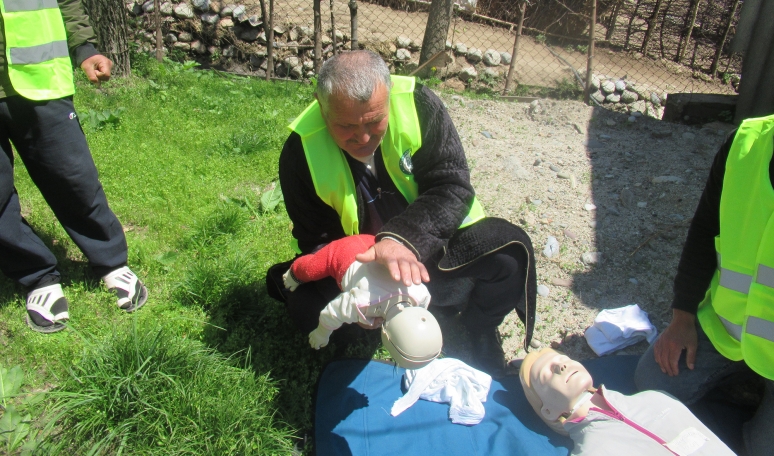
The Aga Khan Agency for Habitat (AKAH) Tajikistan, through the financial support of the Government of Switzerland, has completed refresher trainings for the Community Emergency Response Teams (CERTs) formed in Rasht valley.
According to the Aga Khan Development Network (AKDN), the trainings, which were conducted within the Integrated Health and Habitat Improvement (IHHI) project, are designed to enhance the readiness of the CERTs to respond to emergency situations across the Districts of Republican Subordination.
The training prepares the volunteers to be the first responders in the event of a disaster. It reportedly capitalizes on their knowledge of the terrain, language and culture. For example, in Shashvolon, they held a separate training for the women, which was reportedly very well received.
Shukrona, a local nurse and committed community volunteer who helped mobilize her fellow women volunteers agrees, “The training offered a safe place to learn freely and to practice. Women constitute a significant number of our communities so it’s important that their specific needs are considered in emergency response.”
The trainings were undertaken in seven villages of Rasht, Roghun, Lakhsh, Tojikobod, Fayzobod, Nourobod, and Sangvor districts from April 17 to April 20. A total of 210 participants (equal representation of men and women) successfully concluded the two-day training, acquiring renewed theoretical knowledge and practical experience on first aid, Incident Command System (ICS), and search and rescue. They also enhanced techniques in bleeding prevention, cardiopulmonary resuscitation, and victim transportation.
The CERTs were formed under IHHI Phase II in 2018 to complement the habitat improvement components of the project in order to create a resilient environment in Rasht valley. The seven CERTs located in the region’s most vulnerable locations to natural hazards are comprised of members chosen among the local population in collaboration with the local governments and the Committee of Emergency Situation (CoES). These teams serve as volunteers, and consist of males and females aged 18 to 55, including doctors, nurses, engineers and youth from the selected villages. AKAH provides continuous support to the CERTs located in different parts of Tajikistan, in line with its mission of reinforcing the resilience of communities all across the country.
The Aga Khan Agency for Habitat (AKAH), which merges the capabilities of Focus Humanitarian Assistance, the Aga Khan Planning and Building Services, and the Aga Khan Development Network’s Disaster Risk Management Initiative, focuses on preparing for both sudden and slow-onset disasters. AKAH works to ensure that poor people live in physical settings that are as safe as possible from the effects of natural disasters; that residents who do live in high-risk areas are able to cope with disasters in terms of preparedness and response; and that these settings provide access to social and financial services that lead to greater opportunity and a better quality of life. Initially, priority areas of AKAH will include Afghanistan, Pakistan, Tajikistan, Kyrgyzstan, and India.
The Swiss Agency for Development and Cooperation (SDC) is the technical authority of the Federal Department of Foreign Affairs of the Swiss Confederation. SDC is responsible for the overall coordination of activities in developing countries and countries of Eastern Europe. Within its Cooperation Strategy for 2017-2021 for Central Asia, Switzerland focuses on the four sectors in Tajikistan, such as a) Water, Infrastructure and Climate Change; b) Health; c) Governance, Institutions and Decentralization; d) Employment and Economic Development. The overall goal of the Swiss Cooperation in Tajikistan is peace and social cohesion as well as responsive and inclusive institutions and sustainable development to improve the population’s well-being.