Asia-Plus has talked to Mr. Farrukh Umarov, an executive director of Ilmhona, who told us where the idea came from to visualize our city, and why brand and identity are so important for Dushanbe.
“Each country must have any brand so that to increase its visibility. For Tajikistan, such a brand is our beautiful mountains. And Dushanbe, as the capital of the country, also should crate its unique image,” said Umarov. “The city branding is the understanding, measurement, influence and controlling how the city is admired by foreign and domestic audience.”
According to him, it is important because awareness and reputation are preconditions for attraction and retention of tourists, investors, students and dwellers.
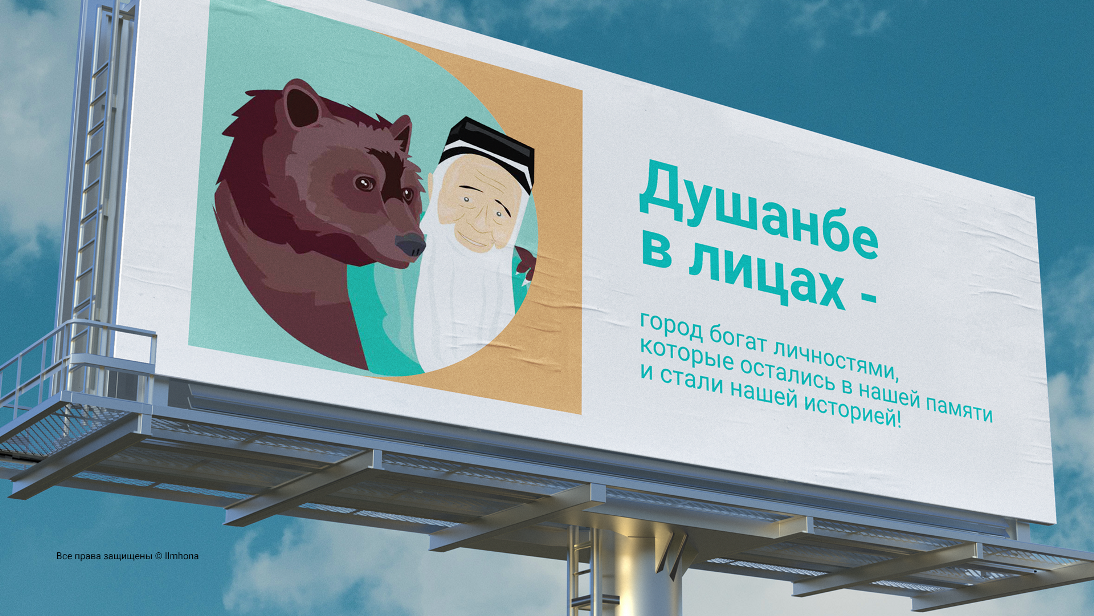
“Guys from our graphic design course have worked on this idea,” said Ilmhona executive director. “All cities attracting many tourists have their unique branding and identity. We wanted Dushanbe to have its own identity.”
One of authors of the idea, Ms. Shirin Rahmonova, said there were many symbols of the Tajik capital but the brightest symbol and real brand of Dushanbe became an old man with his bear, Maria. “Probably every true resident of the capital remembers them,” Shirin said.
The old man with his bear, Maria, was known as the Bear Man of Dushanbe. The old man and his bear were a regular fixture in the Tajik capital for the over 20 years, strolling along streets, posing for photos, even riding public transport.
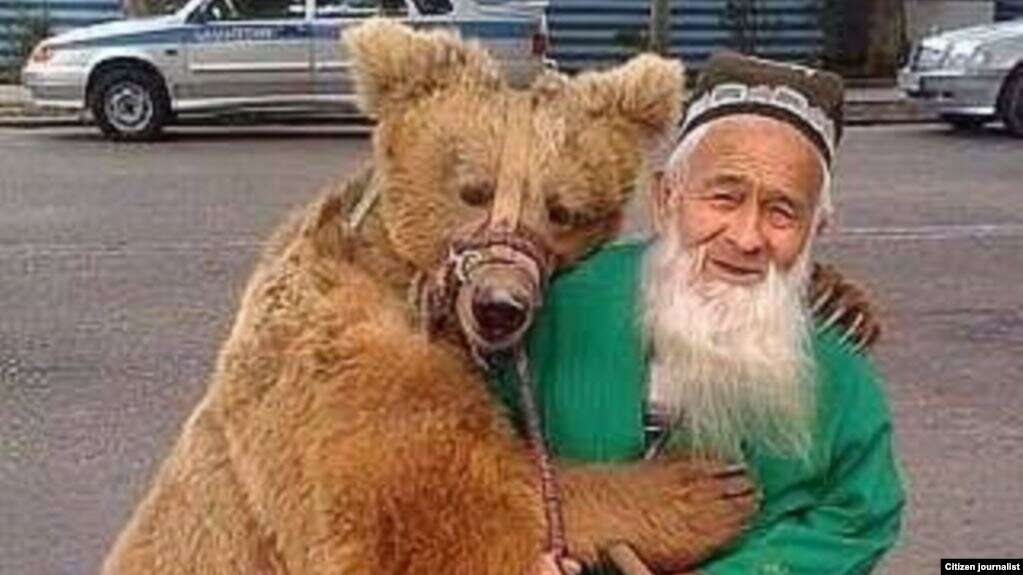
In interviews with Tajik media over the years, Talabsho Sheikhov said he first saw Maria — then a six-week-old cub — at a neighbor's house in the early 1990s. The neighbor wanted to sell the cub, whose mother was killed by hunters. Sheikhov reportedly traded a goat for the cub and took her home.
He named her Maria, after the heroine of a Mexican soap opera that was wildly popular on a Russian television channel at the time.
Maria was raised with bottle milk and food Sheikhov's “other 13 children” shared in their house in Yalash, a village in Tajikistan's eastern Lakhsh (formerly Jirgatol) district.
But Maria's ever-growing appetite soon became increasingly unaffordable for her master. Sheikhov left the village and his family behind and settled with Maria in Dushanbe, where he put the bear to work to help foot the bill.
Residents say she would entertain children with her forward rolls and give them rides on her back under the watchful eyes of her master, who kept Maria on a leash.
The duo become well-known in Dushanbe, where they could be seen riding a bus, sharing a meal, or carefully crossing a busy street.
Talabsho Sheikhov was in his 80s when he died in 2013. Maria died two months later.