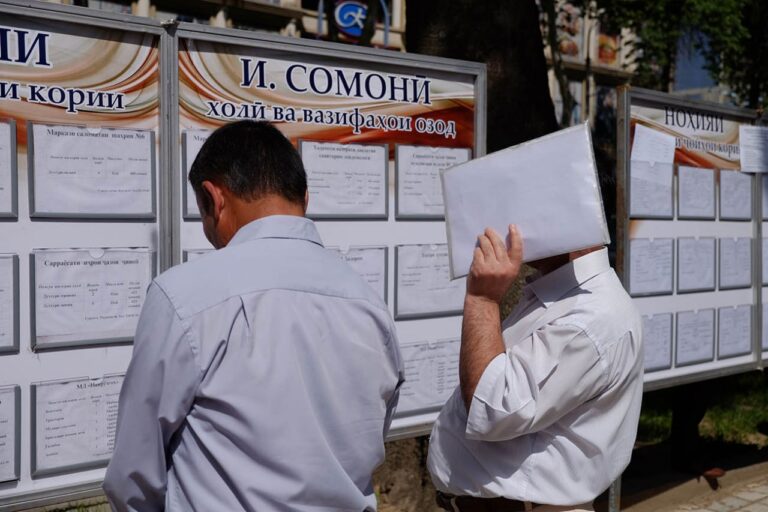
Tajikistan’s war on independent journalists is reaching a new pitch, not just growing in intensity, but also taking on new forms, according to Eurasianet.
This week, Tajik national television broadcast a three-part series focusing on the regime’s perceived enemies. Two episodes were devoted to Muhiddin Kabiri, an exiled opposition politician who leads the banned Islamic Renaissance Party of Tajikistan, or IRPT.
In the third, one-hour-long episode, attention turned to journalists said to be working for Prague-based outlet Akhbor. The program referred to reporters by name and detailed the amounts of money they are meant to have earned from working for the website.
One correspondent from the town of Penjikent, Khurshed Fozilov, is said to have received $3,910 over three years. Another, Saodat Ismoilova, from the Asht district in northern Sughd province, earned $1,670.
An ominous voiceover then proceeds to allege, without producing evidence, that the editor of the website, Mirzo Salimpour, is working at the behest of Kabiri and a “Muslim country known to everybody.”
Akhbor’s correspondents are then accused of working without accreditation for a media outlet based outside the country. While doing so, they have avoided paying taxes on their incomes, the program states.
Pressure on reporters has reportedly taken on more direct forms in recent weeks. Around a dozen independent journalists have been summoned to the Prosecutor General’s Office and the State Committee for National Security (SCNS) for lengthy interrogations. During those exchanges, reporters have reportedly sometimes been directed to write articles at the behest of security bodies.
The SCNS has also initiated tax probes into media outlets receiving foreign grants and demanding more information about the ways in which these funds are being spent, Eurasianet said.
On June 10, deputies in the lower house (Majlisi Namoyandagon) of parliament voted in favor of making it an administrative offense to spread “inaccurate” and “untruthful” information about the COVID-19 pandemic through media or the internet. Individuals found to be in breach will face fines of up to 580 somoni, while legal entities, ostensibly meaning media outlets, may have to pay 11,600 somoni.
Recall, the Paris-based media watchdog Reporters Without Borders (RSF) has called for the withdrawal of newly approved legislative amendments in Tajikistan under which false or inaccurate COVID-19 coverage would be subject to heavy fines. RSF warned that the amendments could lead to censorship and other violations of press freedom.
“This new, vaguely defined legislation could be exploited to violate the right to information,” Jeanne Cavelier, the head of RSF's Eastern Europe and Central Asia desk, said in a statement published on June 12.
RSF recommends that the Tajik authorities should combat disinformation by means of self-regulatory mechanisms that promote the best journalists standards and ethics, such as the Journalism Trust Initiative.
In its most recent World Press Freedom Index, RSF ranked Tajikistan 161st out of 180 listed countries and territories.
Civic society’s organizations, media outlets and independent journalists of Tajikistan have called on President Emomali Rahmon and Majlisi Milli (Tajikistan’s upper chamber of parliament) Speaker Rustam Emomali not to approve and sign amendments recently made to the country’s administrative code.
Representatives of Tajikistan’s civic society express serious concern that “the amendments will seriously worsen an already difficult situation with freedom of speech in the country.”
They emphasize that the amendments can lead to censorship and “cause prosecution of not only media and journalists, but also civic activists for dissemination of information that could be interpreted as knowingly false.”