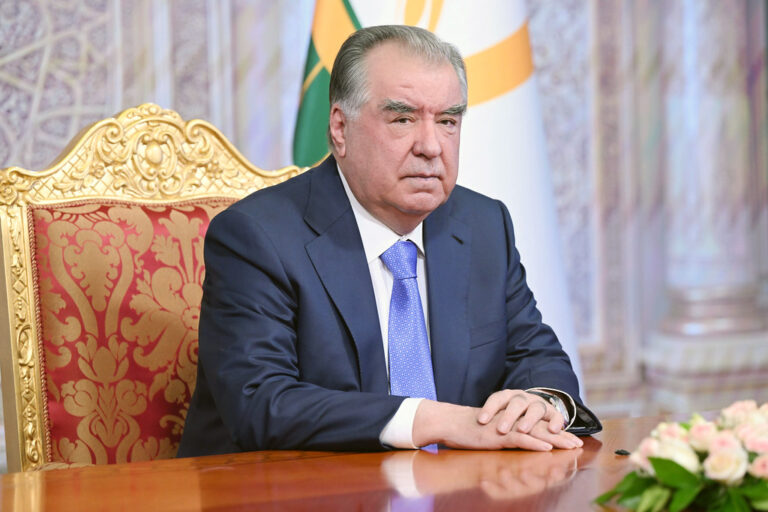
Media watchdog has urged Tajik President Emomali Rahmon to reject proposed legal amendments that it says threaten freedom of speech in Tajikistan.
President Emomali Rahmon should not ratify proposed legal amendments that would threaten free expression in the country, the Committee to Protect Journalists (CPJ) said on June 30.
“The proposed amendments to Tajikistan’s administrative code are a clear license for authorities to expand censorship efforts in the name of fighting the COVID-19 pandemic,” said CPJ Europe and Central Asia Program Coordinator Gulnoza Said. “President Emomali Rahmon should not approve the proposed legislative amendments and should stop this crackdown on the press and social media.”
Nouriddin Qarshiboyev, the head of the National Association of the Independent Mass Media of Tajikistan (Nansmit), told CPJ over the phone that the amendments were “a repressive step that will limit freedom of receiving and spreading information” and said the vague phrasing could empower authorities to crack down on the press in the run-up to the country’s presidential elections later this year.
CPJ emailed the parliamentary and presidential press offices for comment, but did not receive any responses.
Recall, members of Tajikistan’s upper chamber (Majlisi Milli) of parliament on June 26 seconded the amendments made by the government to the country’s administrative code.
The amendments were previously approved in the legislature’s lower house, Majlisi Namoyandagon, on June 10. Deputies in the Majlisi Namoyandagon voted in favor of making it an administrative offense to spread deliberately false information about the pandemic through media or the internet. Individuals found to be in breach will face fines of up to 580 somoni, while legal entities, ostensibly meaning media outlets, may have to pay 11,600 somoni.
The amendments also provide for a fine from 116 to 290 somoni for anyone not wearing a mask in public or failing to practice physical distancing of two meters.
The Paris-based media watchdog Reporters Without Borders (RSF) has called for the withdrawal of newly approved legislative amendments in Tajikistan under which false or inaccurate COVID-19 coverage would be subject to heavy fines. RSF warned that the amendments could lead to censorship and other violations of press freedom.
“This new, vaguely defined legislation could be exploited to violate the right to information,” Jeanne Cavelier, the head of RSF's Eastern Europe and Central Asia desk, said in a statement published on June 12.
RSF recommends that the Tajik authorities should combat disinformation by means of self-regulatory mechanisms that promote the best journalists standards and ethics, such as the Journalism Trust Initiative.
In its most recent World Press Freedom Index, RSF ranked Tajikistan 161st out of 180 listed countries and territories.