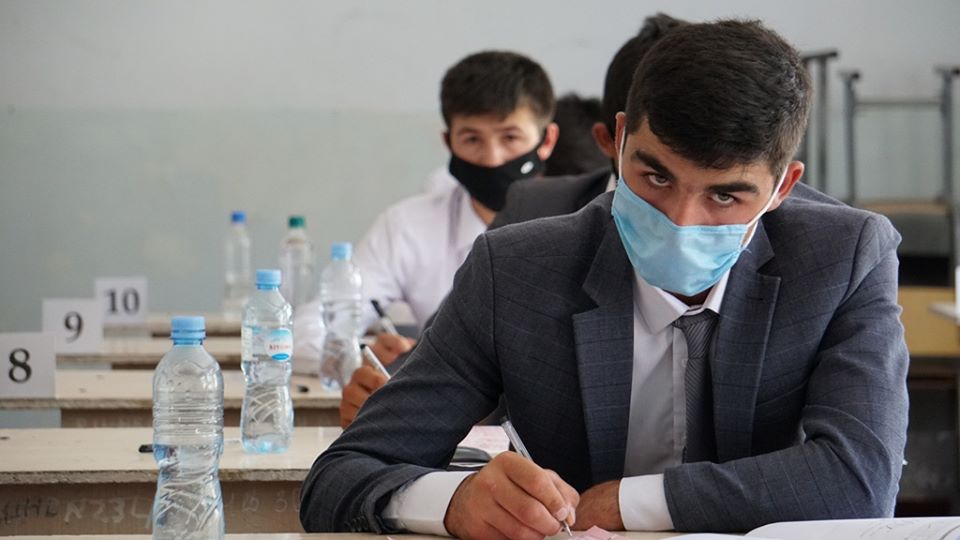
World Bank experts warn that the COVID-19 pandemic can have a detrimental and long-lasting impact on education and human capital, economic and social development in Central Asian countries, where schoolchildren and students make up nearly half of the overall population.
According to World Bank, an online briefing for regional media, experts, academia, and development community in the Central Asian region was held on August 5.
The crisis threatens to deprive this generation of future earnings, as it pushes a large share of Central Asian students into functional illiteracy – inability to read, write, and do math at a level necessary to be productive, World Bank estimates.
Before the pandemic, education across Central Asia was already suffering from low learning levels, as the countries struggled to eliminate learning poverty, distribute equal opportunities to poor learners, and promote inclusion. Students across the region performed 1.5 years below the average of Europe, i.e. an average student in Central Asia was a year and a half behind their peer in Europe. Many students in the region also performed significantly below functional literacy, according to the OECD Program for International Student Assessment (PISA).
Learning inequality is of particular concern, with the gap between students from various income levels widening due to a number of factors, including differential access to distance learning for teachers and students, teaching support, access to teaching and learning materials at home, and household contribution to home schooling. According to PISA, in Kazakhstan, children from the poorest families were one year behind their peers, while in Kyrgyzstan poor students were 2.5 years behind.
The COVID-19 pandemic has further exacerbated the learning deficiencies, with school closures impacting already marginalized groups, including students from socio-economically disadvantaged backgrounds, learners with disabilities and minorities.
“The COVID-19 pandemic is dealing a blow to education and learning so destructive we will feel its negative effects for decades to come, including $44 billion in economic loss in Central Asia alone, and this is not our most pessimistic scenario,” said Ayesha Vawda, Lead Education Specialist at the World Bank in Central Asia during the event. “Central Asian countries took swift action to deliver emergency learning via multiple channels and modes. Now is the time for governments to respond in a way that lays the foundation of the new education system – one that is high quality, resilient and equitable”.
During the briefing, the World Bank stressed that education needs to be at the forefront of the national recovery plans in Central Asia. The countries need to protect education budgets, improve the quality of distance learning, allow flexibility in the curricula to focus on competencies and skills instead of knowledge, empower teachers with effective remediation strategies and with diagnostic and formative assessments and increased instruction time to allow recovery of learning losses.
As teachers become more aware of the learning, and learning loss of each child, remedial education plans will need to be developed. Special attention will need to be given to those students who have suffered the most during the school closures. The countries also need to develop digital skills amongst students, youth and teachers and increase teacher-student interaction on different distance learning platforms to better respond to the needs of the continuing crises.
Currently, the World Bank has reportedly adapted three education projects in the region to respond to COVID: in Kazakhstan, Kyrgyzstan, and Uzbekistan. Through these projects, they were able to mobilize some support for emergency and remote learning.