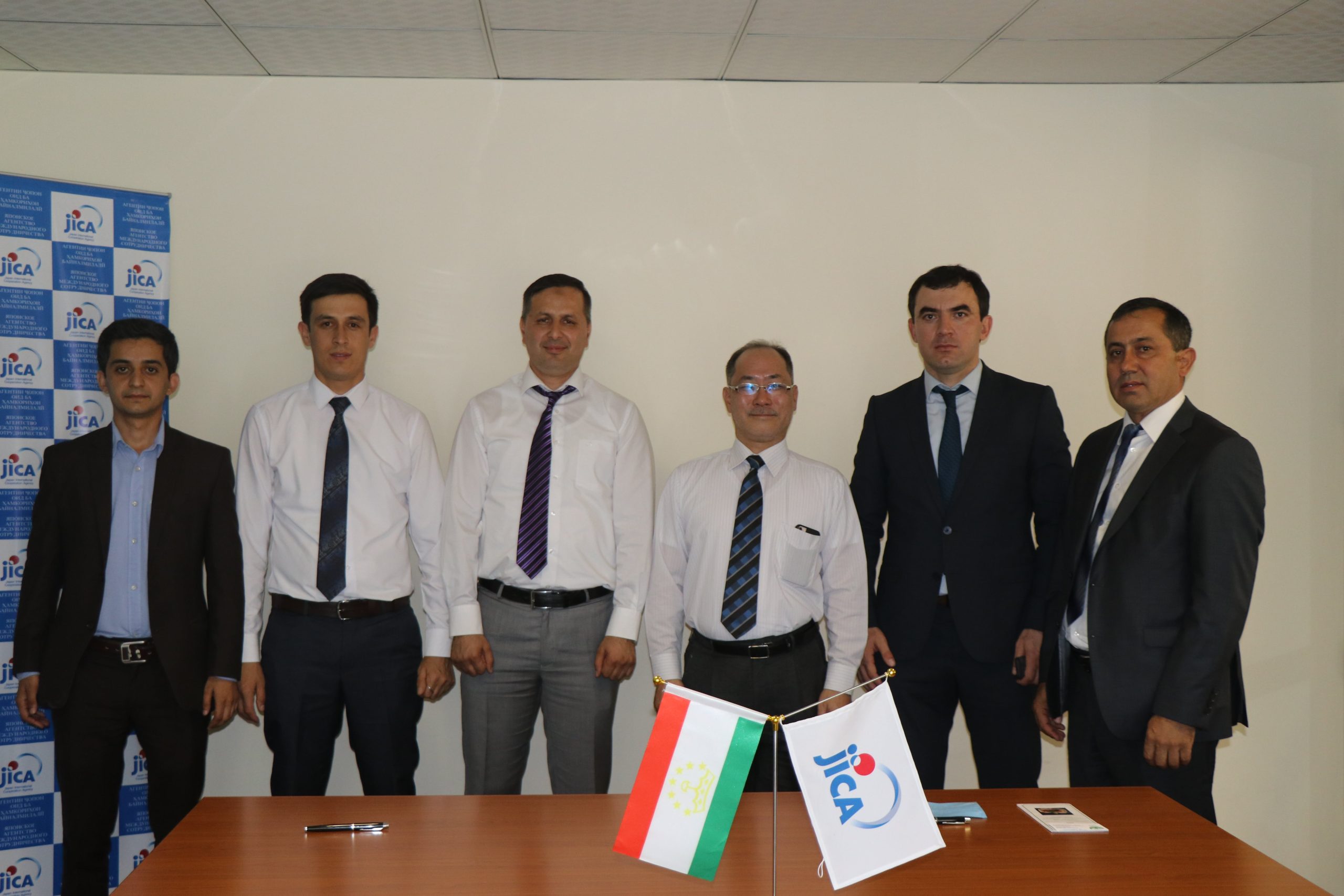
On August 14, the signing ceremony for five Mini-Grant Projects took place at Japan International Cooperation Agency (JICA) Tajikistan Office. The Mini-Grant Agreements were signed by Mr. Hideki Tanabe, Chief Representative of JICA and finalists of Mini-Grant competition.
According to JICA Tajikistan Office, five projects in such sectors like transport, tourism, agriculture and food safety will be implemented for the sake of Tajik citizens and aiming at 1) training of specialists SEHM and SETM in analysis, forecasting and budgeting based on experience of Japan; 2) building capacity of local specialists and stakeholders in the elaboration of local Plans on development of Agro tourism; 3) to find the ways for improvement of local seed production and better access to high quality seed in Tajikistan and 4) insuring food quality and safety.
In his opening remarks, the Chief Representative of JICA, Mr. Hideki Tanabe congratulated the winners and wished them effective and successful realization of the projects in this hard time.
In turn, the winners thanked JICA for the given opportunity to implement their initiatives and ideas, and assured that all projects shall be successfully implemented with the set objectives to be achieved.
This is the third round of “Mini-Grant” implementation in Tajikistan that was started in 2018 with the purpose of supporting ex-participants of JICA training program to realize their activities aimed at contributing to socio-economic development of Tajikistan. Within 2 years, 11 projects in different sectors like transport, health, irrigation, agriculture and others were implemented in amount of more than 40 000 USD.
It is expected that this initiative will play important role in strengthening the friendship of Japan and Tajikistan, and the process of project implementation will improve civil servants’ skill on project management.
JICA began its technical cooperation with Tajikistan in 1993 by inviting Tajik officials to gain knowledge and experience on governance and macroeconomics development. As of January 2018, a total number of participants to JICA’s Knowledge Co-Creation Programs, formerly called the Training Programs, has exceeded 2200 people. JICA Office was established in 2006 in Tajikistan and since then various Grant Financial Assistance and Technical Cooperation projects have been implemented more dynamically, aiming at improving living standard of Tajik people for the sectors such as agriculture and rural development, water supply, health, transport, energy, capacity building as well as SME promotion. JICA’s cumulative investment portfolio in Tajikistan in all sectors comprises 41 projects amounting to more than 401.4 million USD (83.7 million USD for Technical Cooperation and 317.7 million USD for Grant Assistance), including 16 ongoing projects.