



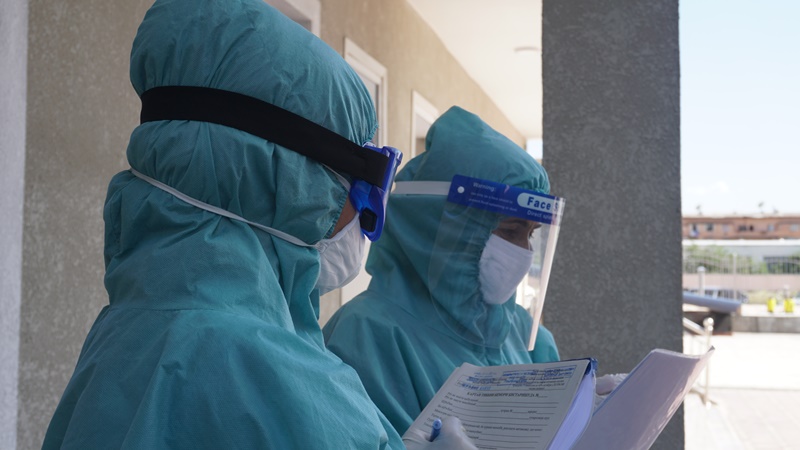
Official statistics show little growth, and Khujand residents sound the alarm.
«The number of cases of pneumonia and confirmed cases of COVID-19 has slightly increased over the past three weeks», – said in an interview with “Radio Ozodi”, WHO Resident Representative in Tajikistan Bakhtygul Karryeva.
Is it connected with the beginning of the school year, she answered:
«The question is not whether to open or not open schools, but how to ensure the safety and health of schools. It is about informing about the risks to public health, and not only in relation to children, but also those who come into contact with them, as well as the risks of the spread of the virus among the population. Schools should not be seen as an isolated place, but as a general segment of society, and therefore should be widely informed about the risks of infection in schools. Over the past three weeks, the number of pneumonia cases and confirmed cases of COVID-19 has slightly increased.
A COVID-19 control management system was created together with the Ministry of Health, and now the selected domestic specialists will monitor the current situation with COVID-19 in the country.».
She noted that the decision to reopen schools was taken by local authorities, and the responsibility for compliance with these principles lies with the republican and local authorities. And the World Health Organization is ready to help the authorities adapt the standards to the specific situation in Tajikistan.
Bakhtygul Karryeva also said in an interview that several laboratories were opened in Tajikistan with the support of the state, donors and partners.
«However, due to the lack of laboratory materials, all countries, including Tajikistan, face the problem of a shortage of tests».
WHO Resident Representative noted that any mass campaign, such as elections, must be based on an accurate assessment of its risks.
Karryeva noted that the decision to hold the elections has already been made, and now it is important to promote the observance of rules and regulations, wash your hands, keep your distance, use a protective mask, etc.
According to her, the COVID-19 infection is still widespread in the country and it is very important to continue measures to prevent its spread.







