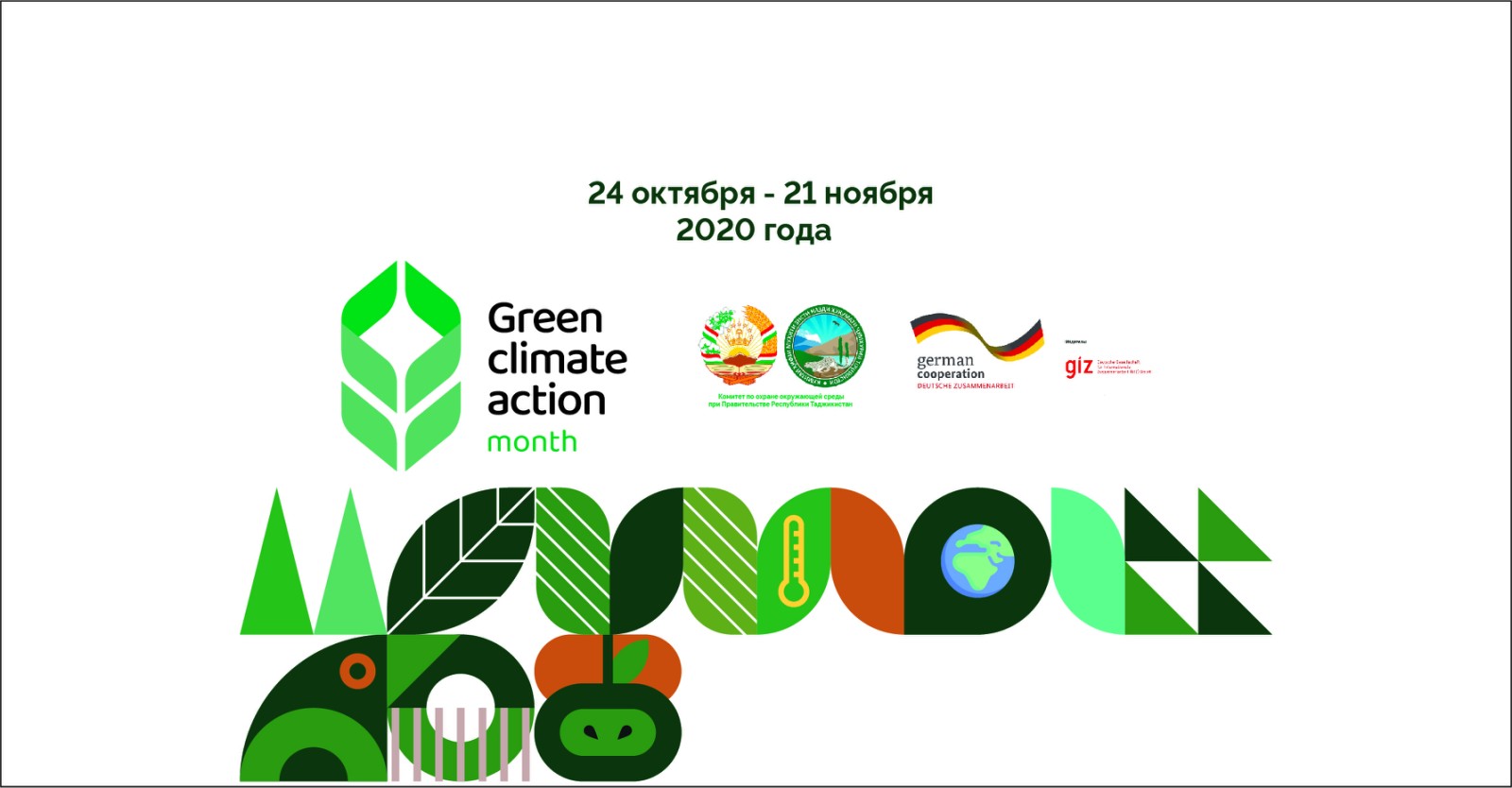
The Committee for Environmental Protection (CEP) under the Government of Tajikistan in cooperation with German Enterprise for International Cooperation (GIZ) have launched the Green Climate Action Month as part of a partnership to strengthen action on climate change and biodiversity conservation under the country’s commitment to the International Paris Agreement on Climate Change and Convention on Biological Diversity.
The Green Climate Action Month starts on October 24, 2020, offering a range of inspiring online events such as climate action challenges, art competitions, quizzes, a student debate, a podcast series and lectures with experts, and ends with a panel discussion with representatives of government agencies, civil society, and the international community on November 20.
The Green Climate Action Month builds upon an improved understanding and vigilance towards environmental and climate change issues worldwide. It aims at raising awareness and learning on these topics through online events accessible throughout Tajikistan and beyond. Ultimately, the activities consider ways to reinforce environmental and climate topics in the country’s national agendas.
Climate change is intensifying the effects of environmental degradation and affects many parts of Tajikistan’s economy. Hence, it needs to be considered in the country’s planning processes across sectors, such as health, education, agriculture and migration. The Action Month is designed to also raise awareness on the cross-sectoral nature of climate change, to nudge behavior change and to inspire people for climate action.
In addition, the COVID 19 pandemic has shown its negative effects on all spheres of socio-economic life of the world.
Additionally, to its direct effects on the health system, it also has a direct impact on the process of our lives, especially the use of electronic means is proof of this. Timely measures, along with measures to mitigate the effects of the current crisis, guarantee the security of the environment and a sustainable future for the people of Tajikistan.
GIZ, on behalf of the German Federal Ministry for Economic Cooperation and Development (BMZ) and the Ministry for the Environment, Nature Conservation and Nuclear Safety (BMU), promotes the sustainable management of natural resources, adaptation to climate change, and conservation of biodiversity in close cooperation with national and local partners in Tajikistan. Through several projects, the joint effort is put on protecting the unique and precious environment of Central Asia, improving the livelihoods of rural communities, and strengthening their social and physical resilience.