A large number of people in Tajikistan have been applying for U.S. visas through the green card lottery, Russian citizenship or, in more extreme cases, trying to obtain political asylum in Europe, according to Eurasianet.
The window for applying for the green card lottery this year ran from October 7 to November 10.
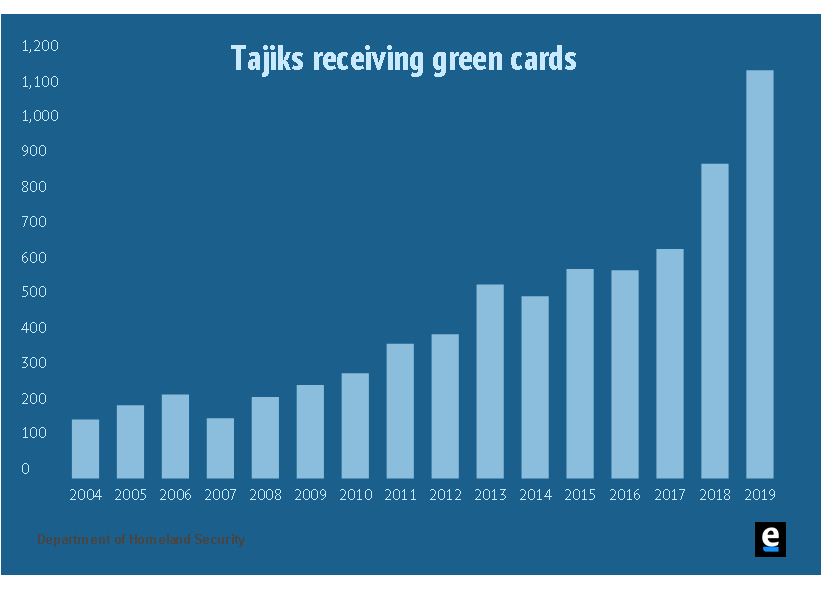
According to the most recent statistics available from the U.S. Department of Homeland Security, over the past 16 years, about 7,300 people born in Tajikistan have received green cards.
Russia represents a more traditional and easier way out. And this is not just about the manual laborers who migrate for months or even years at a time to earn the meager incomes that they send to families back home.
People with advanced educations are well-positioned to find permanent jobs as part of Moscow’s resettlement programs. Applicants must speak Russian, be qualified in a profession and undergo an interview process. A streamlined citizenship procedure is in place for doctors and teachers.
What is especially appealing about this option is that under a dual citizenship agreement between Tajikistan and Russia, obtaining a new citizenship does not automatically entail losing the old one.
This has had predictably alarming consequences inside Tajikistan.
During the drives of registration for resettlement in Russia, hundreds of people will line up outside the premises of the Russian Interior Ministry's representative office in Dushanbe. The jostling can be so intense that scuffles will sometimes break out.
A more drawn-out citizenship procedure that is also popular is to just live, work and pay taxes in Russia for a period of at least five years.
The trend is unmistakable.
According to figures from Russia’s Interior Ministry, more than 35,700 nationals of Tajikistan received citizenship in 2018. In 2019, it was 44,700. In the first half of this year, around 31,300 Tajiks obtained Russian citizenship.
And then there is another contingent of Tajiks who are leaving the country on political grounds – or at least what they describe as such.
This emigration began in 2015, which marked the start to a major wave of arrests of opposition politicians and activists following the banning of the Islamic Renaissance Party of Tajikistan, or IRPT, and the Group-24 movement. About 30 journalists have also applied for refugee status in Western countries.
According to data from the United Nations High Commissioner for Refugees, more than 14,000 Tajik citizens applied for political asylum in various countries, mainly in Europe, from 2015 to 2019. Of that total, 6,773 successfully received refugee status.
Besides, the terminal state of the economy remains paramount in the minds of those wishing to leave.