Foreign ministries of Tajikistan and Kyrgyzstan have signed a cooperation program designed for 2021-2022.
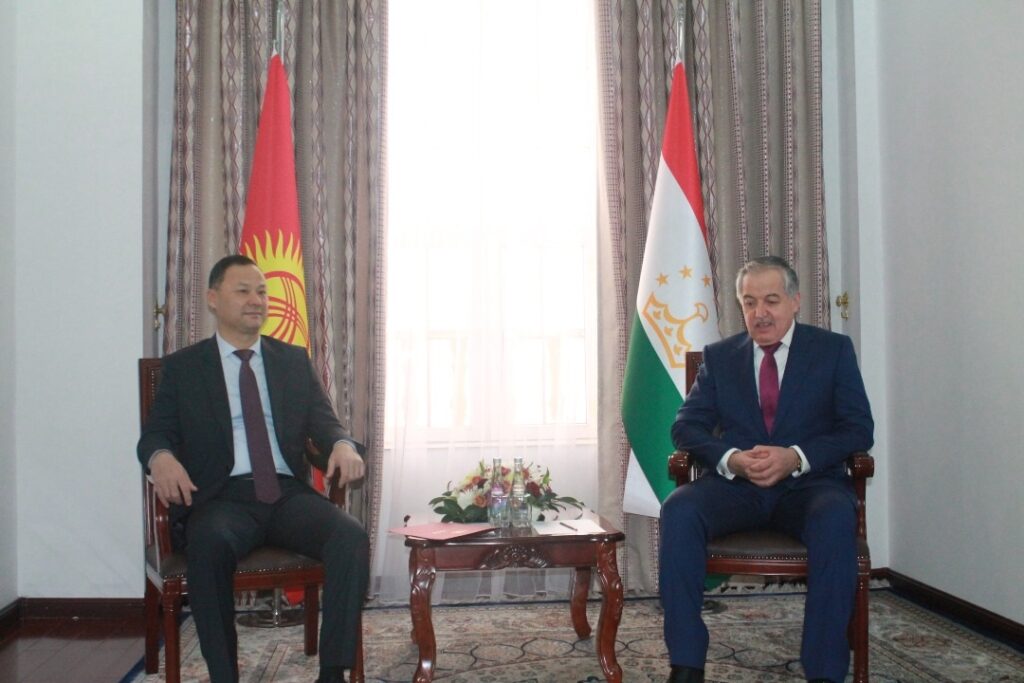
On Thursday November 19, Tajik Foreign Minister Sirojddin Muhriddin held talks here with his Kyrgyz counterpart Ruslan Kazakbayev.
According to the Tajik MFA information department, the two discussed state and prospects of further expansion of bilateral cooperation between Tajikistan and Kyrgyzstan.
A special attention was reportedly given to the issue of delimitation and demarcation of the mutual border. The heads of delegations spoke in support of the full use of the potential of the intergovernmental commission on delimitation and demarcation of the Tajik-Kyrgyz border.
Muhriddin and Kazakbayev also exchanged views on economic, cultural and humanitarian cooperation between the two countries as well as rational use of water resources of trans boundary rivers.
The talks resulted in signing of the cooperation program for 2021-2022, the Tajik MFA information department
Ruslan Kazakbayev (born on May 18, 1967) is Kyrgyz politician and diplomat. HE was appointed Foreign Minister of Kyrgyzstan on October 15, 2020. Prior to this, he served as Foreign Minister of Kyrgyzstan from April 15, 2010 to September 6, 2012. In January-October 2009, he served as First Deputy Foreign Minister of Kyrgyzstan. From 2005 to 2009, Kazakbayev was Kyrgyzstan Consul General to Istanbul, Turkey.
Diplomatic relations between the Republic of Tajikistan and the Kyrgyz Republic were established on January 14, 1993 by signing the Protocol.
The Embassy of the Kyrgyz Republic has functioned in Dushanbe since March 1997 and the Embassy of the Republic of Tajikistan functions in Bishkek.
The basic documents, which regulate the main directions and fundamental principles of the bilateral relations between Tajikistan and Kyrgyz Republic, are “Dushanbe Agreement on the Main Interstate Relations between the Republic of Tajikistan and the Kyrgyz Republic” signed on July 12, 1996 and “The Agreement between the Republic of Tajikistan and the Kyrgyz Republic on Good-Neighborly Relations and Partnerships” signed on May 26, 2004.
Tajikistan and Kyrgyzstan have not yet resolved the border delineation problem. Many border areas in Central Asia have been disputed since the collapse of the Soviet Union in 1991. The situation is particularly complicated near the numerous exclaves in the Ferghana Valley, where the borders of Tajikistan, Uzbekistan, and Kyrgyzstan meet.
The border of Kyrgyzstan and Tajikistan has been the scene of unrest repeatedly since the collapse of the former Soviet Union. The countries share 971 kilometers of border – of which only 504 kilometers has reportedly been properly delineated.
Tajikistan and Kyrgyzstan renewed interest in border delimitation suggests that the governments want to dedicate more attention and resources to the communities living in the Ferghana Valley.