The Government of Tajikistan intends to attract US$500 million of external loans to finance national energy development projects, according to the Ministry of Finance (MoF).
Of this amount, US340 million will be used for completion of construction of the Roghun hydroelectric power plant (HPP).
The Tajik authorities reportedly hope to get these funds from Credit Suisse (Switzerland) and Lansesbank Baden-Wuerttemberg (Germany).
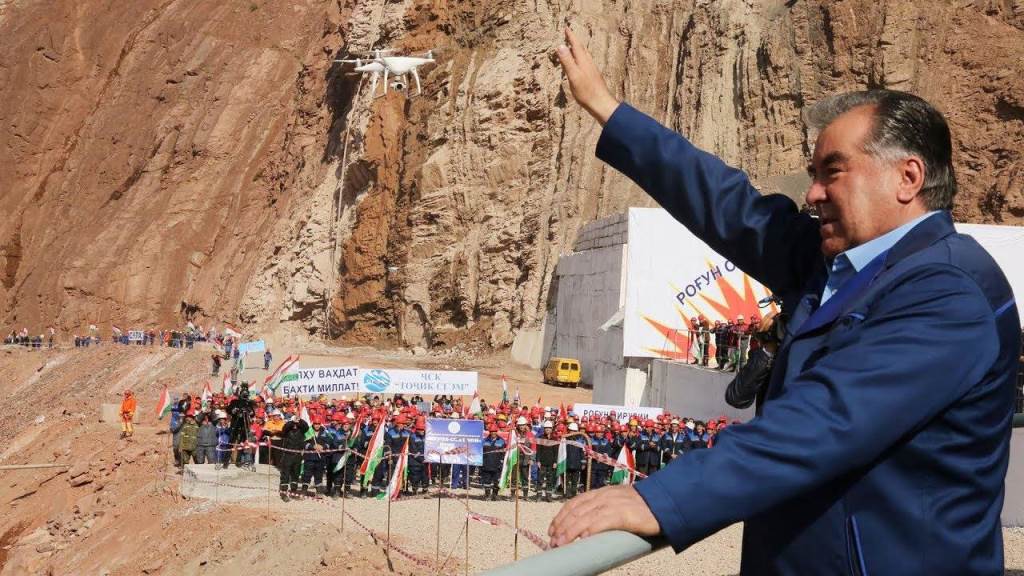
During a visit to the site for construction of the Roghun HPP, President Emomali Rahmon noted in mid-October this year that he ordered a relevant working group to take measures to seek financing sources for construction of the Roghun HPP in 2021.
According to him, about 3 billion somonis will be allocated next year for completion of construction of the hydropower plant.
According to data from a MoF, 1.3 billion somonis have been spent for construction of the Roghun HPP over the first half-year of 2020.
In all, more than 25.3 billion somonis have reportedly been spent for construction of the Roghun HPP since 2008.
The Roghun HPP is an embankment dam in the preliminary stages of construction on the Vakhsh River in southern Tajikistan. It is one of the planned hydroelectric power plants of Vakhsh Cascade.
The Roghun HPP was first proposed in 1959 and a technical scheme was developed by 1965. Construction began in 1976 but the project was frozen after the collapse of the Soviet Union.
An agreement on finishing the construction was signed between Tajikistan and Russia in 1994; however, as the agreement was not implemented, it was denounced by Tajikistan parliament.
In October 2004, Tajikistan signed an agreement with Russia's RusAl aluminum company, according to which RusAl agreed to complete the Roghun facility and rebuild the Tursunzoda aluminum smelter. In August 2007, Tajikistan formally revoked a contract with RusAl, accusing it of failing to fulfill the contract.
In 2016, construction duties on Roghun were assigned to Italian company Salini Impregilo. It is estimated that the project will cost $3.9 billion to complete.
Tajikistan stemmed the flow of the Vakhsh River for construction of the Roghun HPP mega-dam in late October 2016.
The project is broken down into four components, with the most expensive one involving the building of a 335-meter-high rockfill dam — the tallest in the world — which will entail costs of around $1.95 billion. Construction of the Roghun hydropower plant is expected to be completed in 2033.
Two of the six turbines have already started producing energy for sale to raise funding to complete it. The first turbine went into service in November 2018 and the second one was introduced into operation in September last year.