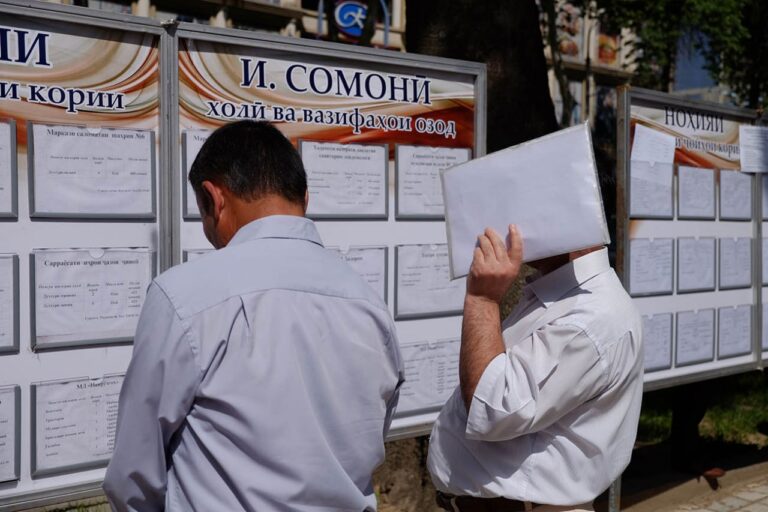
Eurasianet says the need to get to Russia for work drives some in Tajikistan to desperate measures.
Same Khojayev, a young man from the southern district of Khovaling, came up with a convoluted way to circumvent travel restrictions imposed over the COVID-19 outbreak. He conned his way into acquiring a ticket for a charter flight from Dushanbe to Minsk intended for people studying in Belarus and Ukraine.
He then snuck illegally across the border to the east, which is currently forbidden for Tajik nationals.
His father, 62-year-old Akram Khojayev, told Eurasianet that the whole voyage cost about $1,000 – a sum that takes the average Tajik laborer months to recoup.
“If my son is detained, he will be put in prison for at least five years for illegally crossing the border. But remaining in Tajikistan means hunger for the whole family. Over there, he will work on a construction site in a village. There will be fewer checks. That’s what we’re hoping,” Khojayev said.
The shutters came down in spring, just when the bulk of Tajik laborers typically set off for short-term work stints in Russia.
The stakes could not be higher. Unemployment is rife in Tajikistan, and such work as can be found is poorly paid.
In 2019, those payments amounted to around $2.5 billion, equivalent to around 33 percent of gross domestic product. But according to Russia’s banking regulator, remittances in the first half of this year plummeted by almost 40 percent year-on-year.
Travel between Russia and Tajikistan has not ceased entirely, but the limitations are so stringent as to rule out the routine patterns of short-term labor migration. Charter flights are the only way to get from one country to the other.
The Ministry of Labor and Social Protection (MoLSP) estimates that the flow of migrants to Russia is down by 57 percent in 2020.
Anybody unwilling to risk taking a detour reportedly has to fall back on what the local labor market can offer. A common destination is what is known as mardikorbozor, which literally translates as “worker markets.” Men – it is almost always men – huddle in groups by the side of the road and wait for potential employers to turn up with offers of a day’s casual employment.
Jobs offered at the mardikorbozor usually consist of things like plumbing, construction or toil in the fields. Eurasianet was told at one mardikorbozor that if 70 people were once usually to be found waiting around for a job, that number has now shot up to 300.
Meanwhile, Karimjon Yorov, who works with Moscow-based Tong Jahoni rights group, told Eurasianet that salaries for Tajik laborers who have been stranded in Russia have actually increased by between 30 and 100 percent since the pandemic struck.
As a recent paper authored by two Moscow-based scholars, Abubakr Rahmonov and Roman Manshin, has shown, the Russian coffers also make a tidy income from the fees that foreign nationals pay for labor patents, as work permits are known.
Moscow Mayor Sergei Sobyanin was even pressed to note in 2016 that the city’s budget had earned more from the sale of work permits than from oil companies based there.
And all that doesn’t account for the money that expatriate workers leave in Russia through spending on accommodation, transportation, food and other services.