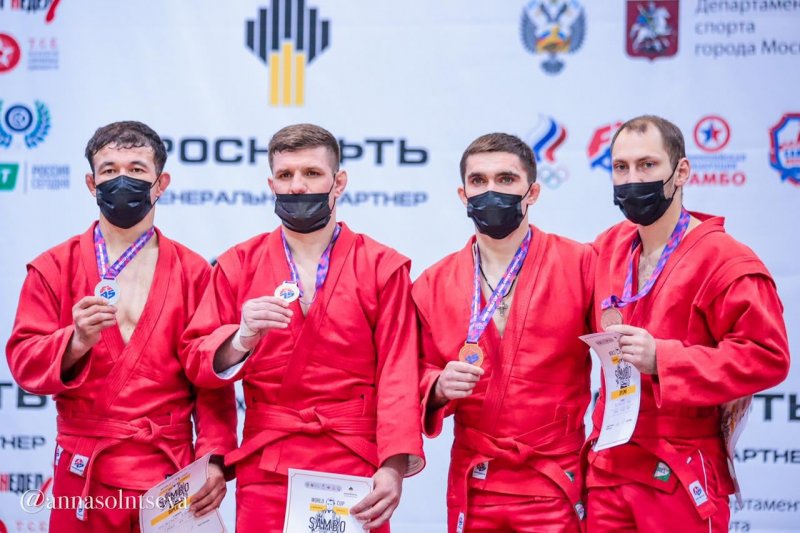
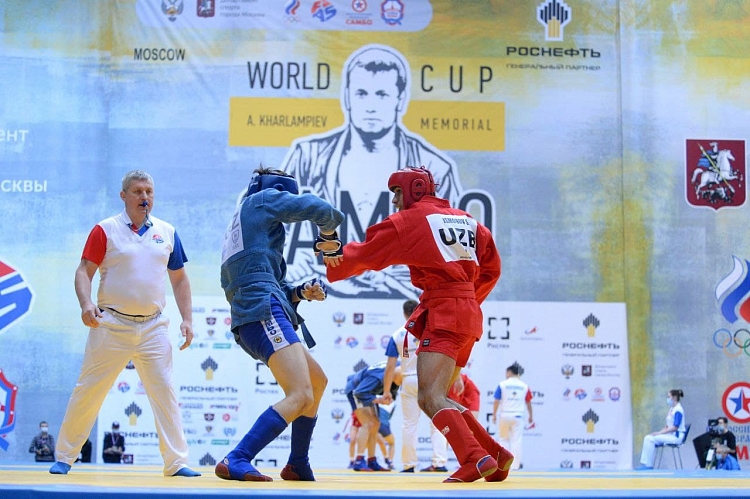
The first day of the Sambo World Cup “A. Kharlampiyev Memorial” took place in Moscow on March 25.
Tajik sambo fighter Khoushqadam Khusravov won the gold medal for Tajikistan, finishing first in -64kg weight category. In final, he defeated Uzbek sambo fighter Homidjon Muminov.
Another Tajik sambo fighter Jamshed Safarov won the bronze medal for Tajikistan in combat sambo in -71kg weight category.
In all, eight Tajik athletes are participating at the Sambo World Cup “A. Kharlampiyev Memorial” that is concluding today.
Anatoly Kharlampiyev (October 29, 1906 – April 16, 1979), was a Russian researcher of various kinds of national wrestling and martial arts, Merited Master of Sports of the USSR, and Honored Coach of Sports of the USSR. He was one of the founders of Sambo, a martial art technique developed in the Soviet Union. In 1938, Kharlampiyev presented Sambo to the USSR All-Union Sports Committee, which recognized the martial art as an official sport.
Sambo is a Soviet martial art and combat sport. It originated in the Russian SFSR in Soviet Union. The word "SAMBO" is a portmanteau for samozashchita bez oruzhiya, which literally translates as "self-defense without weapons." Sambo is relatively modern, since its development began in the early 1920s by the Soviet NKVD and Red Army to improve hand-to-hand combat abilities of the servicemen. It was intended to be a merger of the most effective techniques of other martial arts.
Sport sambo is stylistically similar to old time catch wrestling and judo, and in a lot of ways influenced by them, but with some differences in rules, protocol, and uniform. More akin to catch wrestling, and in contrast with judo, sambo allows various types of leg locks, while not allowing chokeholds. It also focuses on throwing, ground work and submissions, with very few restrictions on gripping and holds.