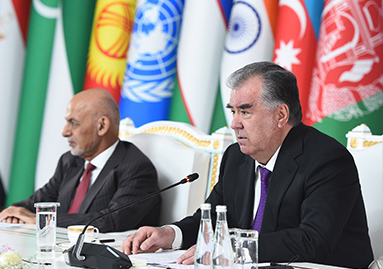
In an opening speech delivered at the 9th Ministerial Meeting of the Heart of Asia-Istanbul Process in Dushanbe, Tajik President Emomali Rahmon noted on March 30 the energy sector is the key for all sectors of the economy and the societal development. Its comprehensive and “effective use can raise our countries to the level of major regional generators of "green energy" and strengthen our capacity in the implementation of the Sustainable Development Goals.”
He said the global trend towards a “green economy” and the efforts of the international community to reduce greenhouse gas emissions, which are recognized to be one of the factors of climate change, are peculiarities of the current time.
Tajikistan has reportedly abundant hydropower resources, which are an important source of renewable energy. “We strive to increase the generation of environment-friendly hydropower for the benefit of all countries in the region and expand the opportunities for its delivery to the regional energy market.”
According to him, Tajikistan annually supplies between 1 to 1.5 billion kWh of electricity to Afghanistan. Over the past decade, Tajikistan has reportedly supplied more than 10 billion kWh of electricity to this neighboring country.
“For these purposes, we have constructed and put into operation two power transmission lines – one 110 and 220 kV with a capacity of 500MW from Tajikistan to Pul-e-Khumri in Afghanistan,” Rahmon said.
“There is an enormous potential for energy cooperation, and we stand ready for comprehensive cooperation in this strategic area. At the same time, we are eager to increase electricity supplies to Afghanistan.”
In this regard, the issue of development and implementation of projects for the interconnection of power grids in the region is of particular importance. The implementation of the CASA-1000 project, which provides for the transmission of electricity from Tajikistan and Kyrgyzstan to Pakistan through the territory of Afghanistan, is very important.
The construction of Roghun-Pul-e Khumri 500KV high-voltage transmission line, the feasibility study of which is being launched, is also an important and timely step, Tajik leader noted.
According to him, the construction of various hydropower plants in the border areas, including the implementation of the Sebzor hydropower project in the Gorno-Badakhshan Autonomous Region of Tajikistan, can be of great importance for improving the living standards of our friendly and neighboring people.
“At the same time, Tajikistan supports Afghanistan's plans to implement regional projects in the energy sector, including the construction of high-voltage transmission lines and other transnational energy facilities,” Rahmon said.