



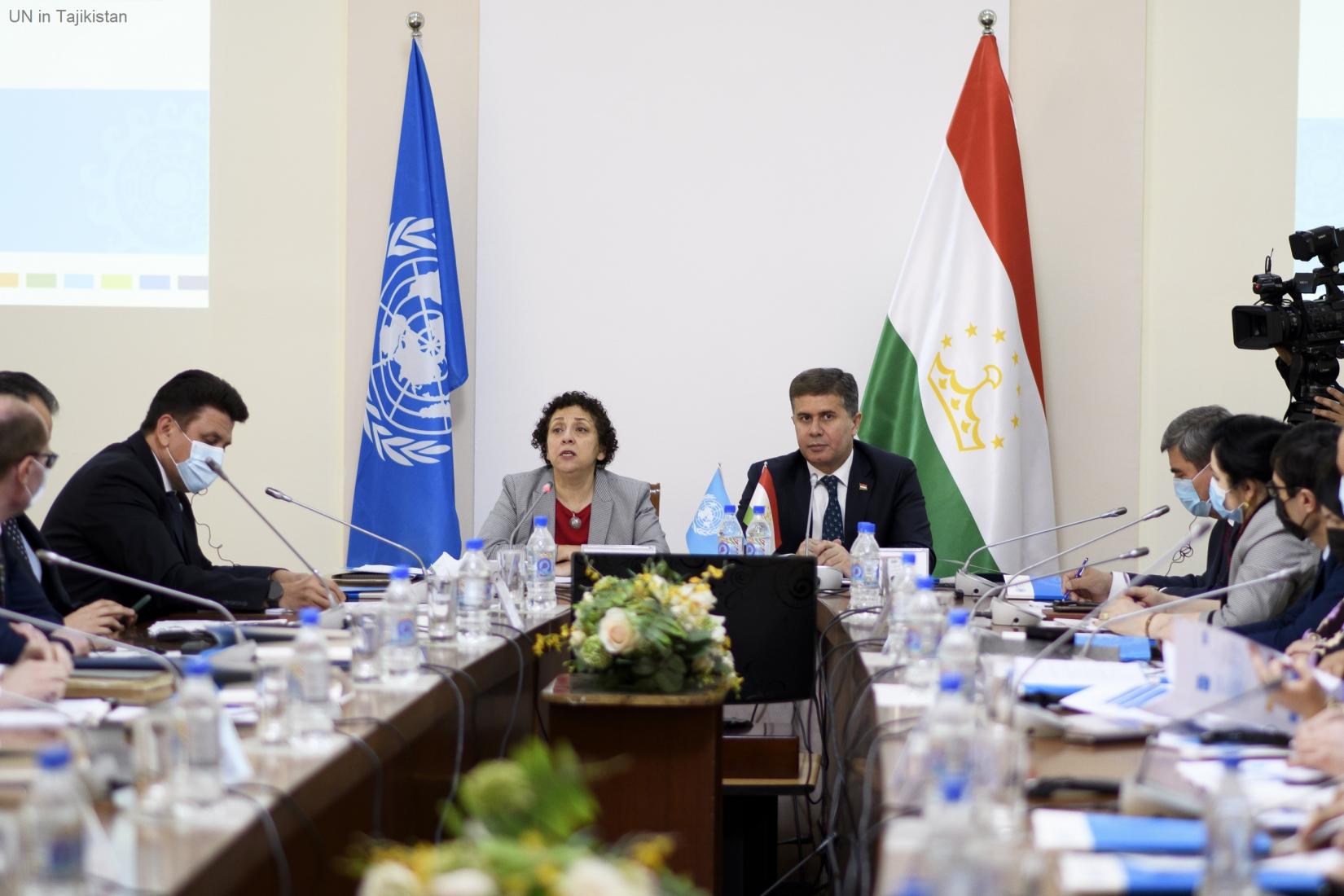
The Government of Tajikistan and the United Nations met on April 2 to review achievements against national development priorities and the Sustainable Development Goals and to discuss upcoming development cooperation plans, according to UNDP Tajikistan.
The meeting was convened by Mr. Zavqi Zavqizoda, Minister of Economic Development and Trade, and Ms. Sezin Sinanoglu, UN Resident Coordinator who co-chair the National Joint Steering Committee responsible for overseeing the implementation of the United National Development Assistance Framework (UNDAF 2016-2022).
The meeting reportedly reviewed the UN’s contribution during 2020 to sustainable development in both the COVID-19 response as well as across the pillars of the UNDAF: democratic governance, rule of law and human rights; inclusive and sustainable economic development; social development (health, education, and social protection) and access to quality services; inclusion and empowerment of vulnerable groups; and environmental sustainability.
Meanwhile, the press center of the Ministry of Economic Development and Trade of Tajikistan (MoEDT) notes that the budget of UNDAF (UNDAF 2016-2022) amounts to more than 363 million U.S. dollars.
During the meeting, Zavqizoda reportedly noted that the country’s leadership had identified priority areas for development of the national economy’s sectors for 2021 and the next seven years.
Zavqizoda noted that average annual GDP growth during 2016-2020 had been provided at the level of not less than 7.0 percent and the GDP volume had increased over the reporting period 1.6 times.
The poverty rate last year was reportedly cut by 28.3 percent compared to 2019.
Tajikistan joined the United Nations on 2 March 1992 as a new independent state. The UN supports Tajikistan to achieve its national priorities. In the immediate years after becoming a UN Member State these priorities were largely related to conflict resolution, mediation, reconciliation and reconstruction. Today, these priorities are focused on sustainable development, peace and security and human rights. The Resident Coordinator leads the UN Country Team (UNCT) and ensures the support of the UN is fully aligned to the Sustainable Development Goals (SDG) as well as to the National Development Strategy 2016-2030.
The UN agencies’ activities in Tajikistan are regulated by the United Nations Development Assistance Framework (UNDAF). The UNDAF for Tajikistan focus on four strategic areas that respond to country development needs and make use of the United Nations’ comparative advantages: 1) Democratic Governance, Rule of Law, and Human Rights; 2) Sustainable and equitable economic development; 3) Social Development, Inclusion and Empowerment; and 4) Resilience and Environmental Sustainability.






