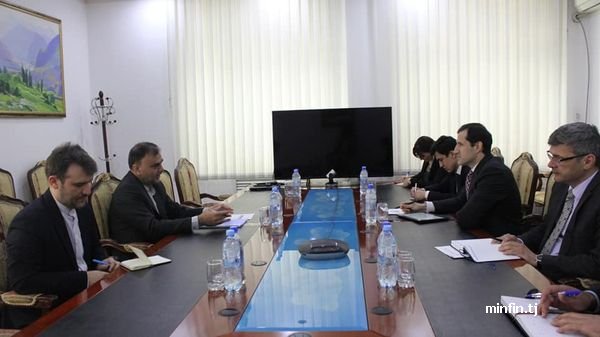
A meeting of Tajik Deputy Finance Minister, Yusuf Majidi, with Iranian Deputy Minister of Energy for International Affairs, Mohammad Ali Farahnakian, took place in Dushanbe on April 15.
According to the Secretariat of the Ministry of Finance (MoF), the two reportedly discussed issues related to further expansion of mutually beneficial cooperation between Tajikistan and Iran.
They also exchanged views on the progress of implementation of agreements reached during the 13th session of Tajikistan-Iran Joint Commission for Trade and Economic Cooperation, which took place in Tehran on December 2-5, 2019.
Both sides stated their readiness to expand cooperation in priority areas, according to the MoF Secretariat.
The MoF Secretariat did not said what issues had been discussed by Yusuf Majidi and Mohammad Ali Farahnakian.
Recall, co-chaired by Tajik Deputy Minister of Energy and Water Resources Nazar Nazarzoda and Iranian Deputy Minister of Energy Mohammad Ali Farahnakian, a meeting of the Committee to Review the Implementation of the Decisions of the 13th Meeting of Tajikistan-Iran Joint Commission for Trade and Economic Cooperation was held through videoconferencing on December 9. The parties considered the current state of interaction between Tajikistan and Iran in various fields and agreed on specific measures to strengthen mutually beneficial cooperation in trade, economic and cultural spheres between the two countries.
Relations between Tajikistan and Iran have come under strain after officials in Tehran invited Muhiddin Kabiri, who chairs the opposition Islamic Renaissance Party (IRPT) banned in Tajikistan, to an international Islamic conference in December 2015. In 2014, Iran was Tajikistan’s third-largest trade partner with trade turnover amounting to about US$200 million, but due to a relationship crisis, the figures dropped to US$60-70 million in 2015.
In 2019, Iran’s President Hassan Rouhani paid a visit to Tajikistan, signaling thaw of relations between the two countries.
On March 29 this year, Tajik President Emomali Rahmon met in Dushanbe with Iran’s Foreign Minister Mohammad Javad Zarif on the sidelines of the regional conference themed “Heart of Asia –Istanbul Process.” The Tajik president’s official website says the construction of the Istiqlol Tunnel was recognized as one of the positive examples of the bilateral cooperation between Tajikistan and Iran. In connection with the aggravation of geopolitical and geostrategic competition, the growing threats and challenges to security and the situation in Afghanistan, it was found necessary to take joint measures to prevent terrorism, extremism, drug trafficking and transnational organized crime. The two sides also discussed other areas of bilateral cooperation between the two countries in the areas such as economy, trade, energy, industry, transportation, science and culture. On March 30, Iran’s Foreign Minister Mohammad Javad Zarif held talks with his Tajik counterpart Sirojiddin Muhriddin. The two discussed the ways to develop bilateral cooperation.