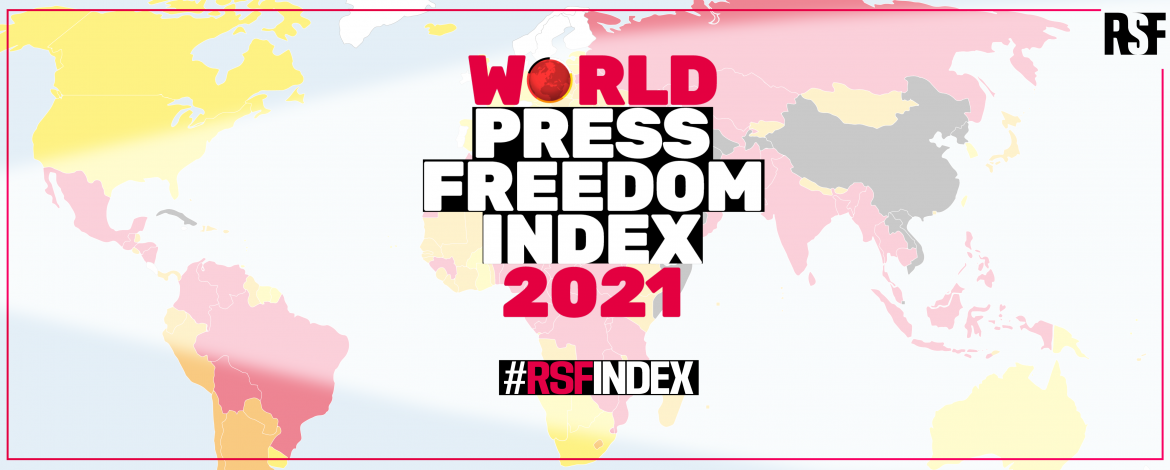
Tajikistan has fallen one position to 162 at the 2021 World Press Freedom Index compiled by Reporters Without Borders (RSF).
RSF says that following the Russian model, other governments, including Tajikistan, used the need to compbat disinformation about COVID-19 as grounds for imposing additional curbs on press freedom.
In Tajikistan, which fell one position to 162, any “false” or “inaccurate” information about serious infectious diseases appearing in the media became punishable by a fine of up to twice the minimum monthly wage or 15 days in prison.
“The aim was clearly to make journalists self-censor any information about the pandemic that did not come from official sources,” RSF said.
As far as other Central Asian nations are concerned, only Kyrgyzstan’s ranking at 79 was in the top half. Kazakhstan reportedly improved two positions to 155; Uzbekistan fell one position to 157; and Turkmenistan improved two slots to 178.
RSF notes that this year’s Index, which evaluates the press freedom situation in 180 countries and territories annually, shows that journalism, which is arguably the best vaccine against the virus of disinformation, is totally blocked or seriously impeded in 73 countries and constrained in 59 others, which together represent 73% of the countries evaluated.
These countries are classified as having “very bad,” “bad” or “problematic” environments for press freedom.
The 2021 Edelman Trust barometer reportedly reveals a disturbing level of public mistrust of journalists, with 59% of respondents in 28 countries saying that journalists deliberately try to mislead the public by reporting information they know to be false. In reality, journalistic pluralism and rigorous reporting serve to combat disinformation and “infodemics”, including false and misleading information.
The Eastern Europe and Central Asia (EECA) region held onto its second-to-last position in the regional rankings.