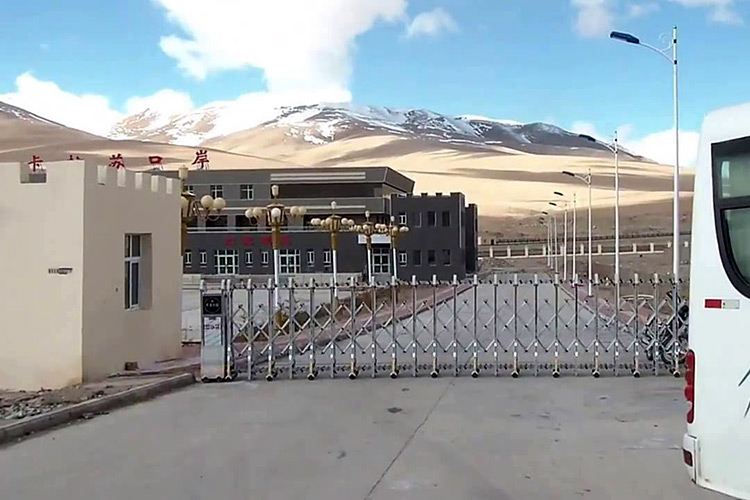
Traffic via Kulma border crossing point (BCP) along the Tajikistan-China border has been restored and it now operate at full capacity.
Tajik Minister of Transport Azim Ibrohim says a telephone conversation between Tajik President Emomali Rahmon and his Chinese counterpart Xi Jinping that took place on March 1 played an important role in the reopening of the checkpoint
Tajik minister stressed that at the suggestion of Tajikistan the Chinese side had reduced the cost of loading and unloading goods at the checkpoint and accelerated the return time of empty containers.
“For example, the sides had previously paid up to US$4,000 at the mentioned checkpoint, for returning empty containers, while now the containers are returned free of charge,” the minister noted.
Recall, a joint working group of Tajikistan and China on reopening the Kulma border crossing point last month held a meeting through video conferencing. Co-chaired by Tajik Minister of Transport Azim Ibrohim and First Deputy Head of China’s Xinjiang Uyghur Autonomous Region (XUAR) Zhang Chunxian, the meeting was reportedly focused on issues related to taking joint measures to reopen the Kulma BCP as soon as possible. The Tajik delegation, in particular, asked the Chinese side to reduce the cost of loading and unloading goods at the BCP, speed up the return time of empty containers and so forth.
The Kulma BCP, which is the only border crossing point along Tajikistan’s common border with China, had been closed for traffic since October last year. The Kulma BCP had reportedly been closed at the initiative of the Chinese authorities due to the coronavirus crisis.
Tajik entrepreneurs, however, associated the closure of the border with the Chinese authorities’ politics aimed at protection of interests of Chinese entrepreneurs.
The Kulma border-crossing checkpoint is the only overland border crossing along the 450-kilometer boundary between Tajikistan’s Gorno-Badakhshan Autonomous Region (GBAO) and China’s XUAR.
Opened in 2004, the Tajik-China trade route runs from Khorog, the capital of Gorno Badakhshan in southeastern Tajikistan, over a high-altitude plateau and then down into China, where it ends in the city of Kashgar, 700 kilometers away.
As conditions are so tough at the Kulma border crossing, which is located on a mountain pass 4,400 meters high, until May 1 2008, the gateway had stayed open only 15 days out of every month, while from November through April it had been closed altogether.
From 2008 to 2012, the Kulma crossing operated every day, except weekends, from May through November.
Tajikistan and China reached an agreement on a year-round operation of the Kulma border-crossing checkpoint on December 29, 2011 but it became possible only in 2012, when all necessary conditions were created to ensure the year-round operation of the Kulma border crossing.
The Kulma Pass is a mountain pass across the Pamir Mountains on the border between the Gorno-Badakhshan Autonomous Region of Tajikistan and the Xinjiang Autonomous Region of China. Asian Highway AH66 runs through the pass.
The pass opens from the north to the southeast, and is 500 m wide from north to south and 1 km in length from east to west with a gentle incline not exceeding 20 degrees. On the Tajik side, the pass is 80 km by road to Murgab. On the Chinese side, the pass is 13.9 km from Karasu, a port of entry on the Karakorum Highway which leads to Tashkurgan (60–70 km) and Kashgar (220 km).
MIGRATON