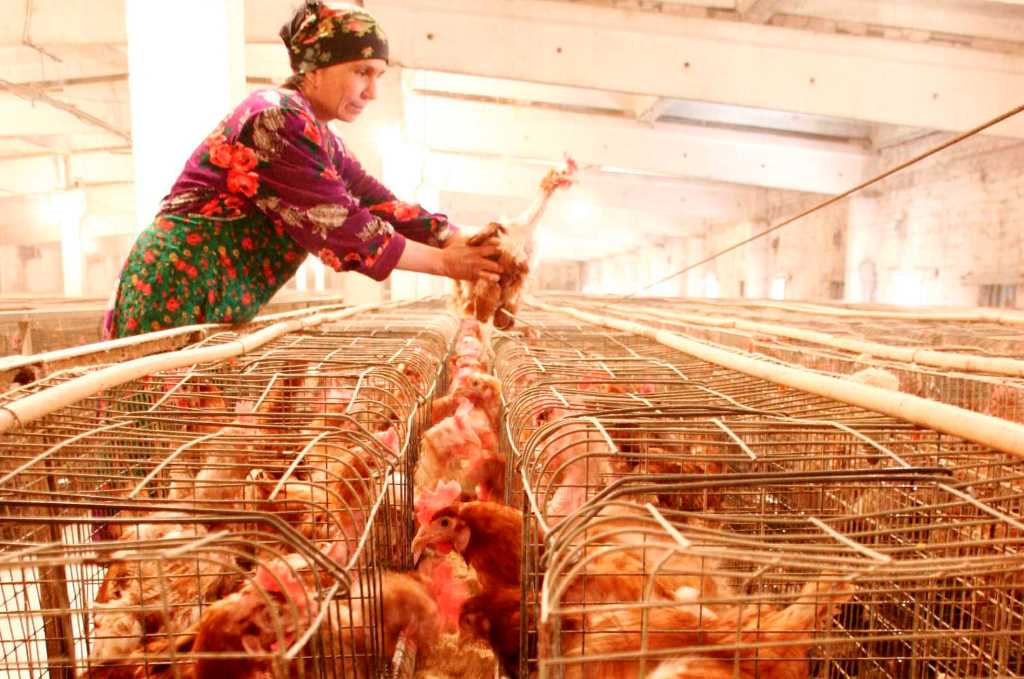
Meat production rises more than 8.0 percent in Tajikistan, says Agriculture Ministry

The Ministry of Agriculture has reviewed the results of work carried out over the first quarter of this year.   Over the first three months of this year, gross agricultural product from all categories of farms has reportedly been more than 1.8 billion somonis (in current prices) and increased by 6.1 percent compared to the same […]

The Ministry of Agriculture has reviewed the results of work carried out over the first quarter of this year.  

Over the first three months of this year, gross agricultural product from all categories of farms has reportedly been more than 1.8 billion somonis (in current prices) and increased by 6.1 percent compared to the same period last year.   .

In the Gorno Badakhshan Autonomous Region (GBAO), the total volume of farm product has increased  by 1.3 percent, in Sughd province – by 7.0 percent, in Khatlon province – by 7.1 percent, and in districts subordinate to the center – 3.1 percent.

At the same time, crop production in Hisor and Roudai (districts subordinate to the center) over the reporting period has fallen 31.5 percent  and 4.1 percent, respectively. 

In January-March this year, all categories of farms have produced more than 3,800 kilograms of vegetables and some 16,000 kilograms of fruits, which is 27 percent and 25 percent more than in the same period last year. 

The Ministry of Agriculture says about 43,000 tons of meat have been produced over the first quarter of this year, which is 8.1 percent more than in the same period last year.

According to data from the Customs Service under the Government of Tajikistan, Tajikistan has imported about 300 tons of meat products over the first two months of this year.  

Over the reporting period, Tajik farming units have reportedly produced 655 tons of fishes, more than 188,000 liters of milk and about 230 million pieces of eggs.  

Despite increase in farm products in percentage terms compared to the same period last year, Tajikistan has failed to meet the needs of the population in agricultural products in accordance with nutritional standards.   A spike in prices gasoline, fodders, fertilizers and chemicals has led to increase in the price of agricultural goods in the country.  

In particular, despite the increase in production, prices for meat and eggs have risen over the reporting period.  Current price for one kilogram of meat is 60-70 somonis and current price for a carton of eggs is 35-36 somonis.   

Join us on social media!

Article translations:

Related Article

Оби зулол
Оби зулол
Tenisi

Most Read

Коммерсбонк Точикистон

Recent Articles

RZD announces the restoration of passenger services between Moscow and Dushanbe

Direct rail services between the capitals of Russia and Tajikistan were suspended in March 2020 due to the COVID-19 pandemic.

#AP30/Stories. “Selam! Heller nichek?” How Tatars live today in Sughd province

On the 30th anniversary of "Asia-Plus," we continue to publish reports that remain relevant even after years. This story was told in 2021, and since then, little has changed in the life of the Tatar community in Tajikistan.

15,000 cameras, drones, and robots: how technology monitors pilgrims in Mecca and Medina

During Hajj 2026, Mecca and Medina were under unprecedented digital control.

Another child in Dushanbe removed from family and sent to boarding school

The Ministry of Internal Affairs reports that the parents did not pay adequate attention to the child.

Emomali Rahmon instructs to address issues in seed production following criticism of the industry

Issues have been noted with certification, seed quality, and the material and technical base of the industry.

Water, climate, and a $130 billion deficit: seven key outcomes of the Water Conference in Dushanbe

At the forum, countries and international organizations discussed new mechanisms for cooperation, investments, and technologies that are essential for addressing the global water crisis.

Eskhata Bank introduces a new generation children’s wallet

"Eshkata Bank" has created a full-fledged digital platform that helps children aged 7 to 16 learn how to manage money.