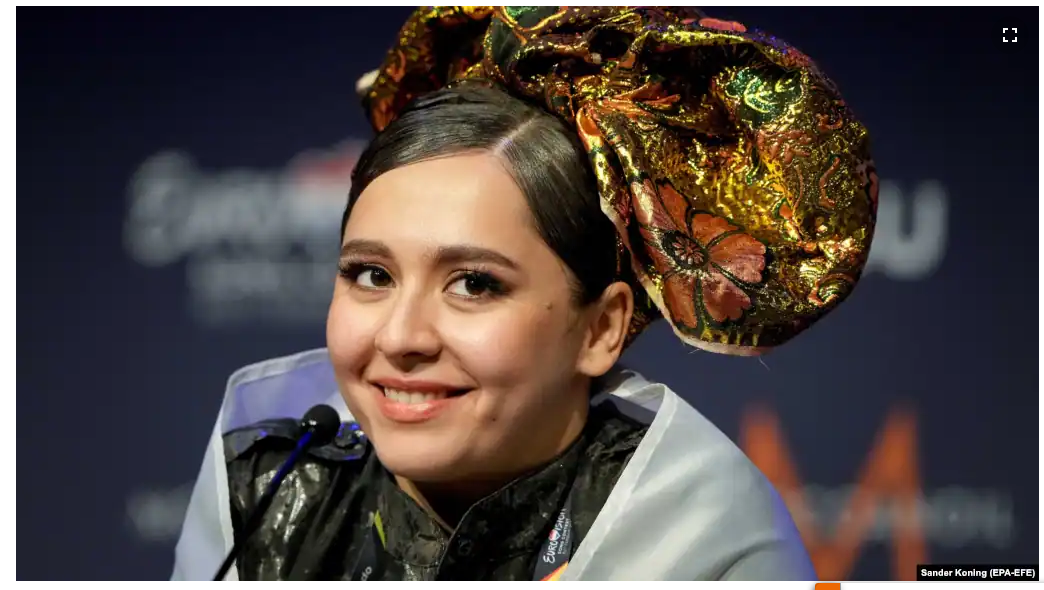
The Tajik-born singer representing Russia in this year's Eurovision Song Contest says her berth in the finals this weekend is "like a dream.” But she says the problems she and other immigrants face in Russia won't ever be far from her mind.
Manizha vowed to maintain the internal bearings that have led the "contradictory" 29-year-old performer and United Nations goodwill ambassador to the brink of international pop fame.
"No position on the top charts, no position in the Eurovision rankings, no prizewinning nor non-prizewinning position can affect my internal position," she told RFE/RL's Tajik Service on May 18 after she advanced from the semifinals along with acts from nine other countries.
"My priority from before Eurovision will remain after it — to tell the truth, to be honest with the audience, [and] to invite the creativity that can inspire people to change and happiness,” she says.
Manizha is a first-generation Tajik immigrant whose selection to represent Russia provoked controversy among critics who suggested the job should be left to ethnic Russians.
She is also a reminder of the painful vestiges of Soviet policies in Central Asia, including the civil war in the early years of post-Soviet independence that drove her family from their native Tajikistan in the mid-
Manizha began performing as a child, and spent time with a handful of bands before going solo and making her music in London and New York.
It has been a long road for the singer and songwriter, whose family reportedly escaped Tajikistan after artillery fire struck their home.
Manizha's publicity material describes her on the Russian-language competitor to Facebook, VKontakte, as "a DIY artist and bright Instagram star."
She has more than half a million followers on Instagram but a more modest 87,000 followers on the mostly Russian VKontakte.
After her selection, challenges emerged from politicians and social-media users questioning her "Russianness" or suggesting that she was an inappropriate choice.
Various estimates put the number of migrant workers in Russia from Manizha's native Tajikistan and the rest of Central Asia — Kazakhstan, Kyrgyzstan, Turkmenistan, and Uzbekistan — at up to around 20 million.
Though they shared Soviet citizenship with Russians during the Soviet era, nationals from those republics are now frequent targets of discrimination, including physical attacks and alleged abuse at the hands of police in today's Russia.
Even as she belts out her song to an expected 180 million or so viewers of this weekend's finals, Manizha told RFE/RL she is less likely to be worrying about herself than the obstacles she and other immigrants face.
"I'll probably only be worrying about the fact that, somehow, our rights are violated, worrying about the fact that someone right now has no opportunity to obtain documents [or] citizenship, or a situation that interferes with living a full life — this is access to education," Manizha said. "I'm more worried about these things."
Manizha is a goodwill ambassador for the UN's refugee agency, the UNHCR.
Speaking to RFE/RL, she talked about feeling like an "other" when visiting Tajikistan.
"It's cool to be born in Tajikistan and leave, preserve your inner Eastern traditions [and], at the same time, become a European resident," she said. "I'm very pleased by support [from Tajiks] because my message is quite contradictory and I, of course, worried about the reaction. But I haven't received a single negative reaction from Tajikistan."
But she also has said she's happy that she's able to write — and find an audience — in Russian.