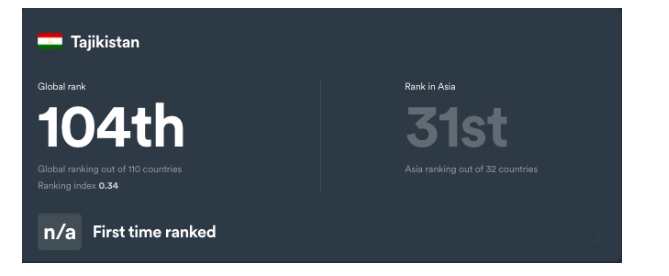
The annual study 2021 Digital Quality of Life Index ranks Tajikistan 104th among 110 countries.
Covering 90% of the global population, the Digital Quality of Life Index (DOL) study is conducted by the cybersecurity company Surfshark and evaluates countries based on a set of five fundamental digital wellbeing pillars.
Tajikistan shows its best results in internet affordability (80th) and e-security (93rd) but strongly lags in e-government (105th), e-infrastructure (107th), and internet quality (103rd).
This study on the quality of a digital wellbeing in 110 countries indexes the countries by looking at five fundamental pillars that define the digital quality of life.
Overall, Tajikistan ranks 104th globally and lags in all five DQL pillars. The study shows Tajikistan's internet quality is one of the worst worldwide, coming last in Central Asia. The country's mobile speeds are one of the lowest globally (12.63 Mbps), ranking 108th among all indexed countries.
However, Tajikistan's broadband speeds rank slightly higher, coming in at 77th place with 31.70 Mbps.
The research shows that Tajikistan's internet affordability is around 70% worse than the global average. Compared to Pakistan, people in Tajikistan reportedly have to work 21 times more to afford mobile internet. At the moment, people in Pakistan have to work 1 hour 13 minutes to afford 1 GB of the cheapest mobile internet, seven times more than the global average. At the same time, to afford broadband internet, people spend approximately 7 hours 24 minutes, almost 2 hours more than the worldwide average.
Tajikistan has the worst internet quality in Central Asia.
The country's mobile speeds are reportedly one of the lowest globally (12.63 Mbps), ranking 108th among all indexed countries.
In an all-around picture, 6 out of 10 countries holding the highest scores are located in Europe, following last year’s trend.
Denmark ranks 1st in DQL for the second year in a row and is closely followed by South Korea. Finland ranks 3rd, while Israel and the U.S. round out the top five of 110 nations that were evaluated.
The bottom 5 countries are Ethiopia, Cambodia, Cameroon, Guatemala, and Angola.
Other significant findings of the report include:
– Broadband is globally less affordable this year. Comparing countries included in both DQL20 and DQL21, people have to work 11% more (25 min more) to afford broadband internet in 2021. However, people have to work 29% less (28 min less) to afford mobile internet this year.
– The world’s worst internet is the least affordable. People in some countries, such as Nigeria, Côte D'Ivoire and Mali require approximately a week’s worth of work to afford the internet.
– Investing in electronic infrastructure and electronic government contributes to people’s digital wellbeing the most.
The 2021 DQL research examined a total population of more than 6.9 billion people in terms of five core pillars and 14 underpinning indicators that provide a comprehensive measure. The study is based on open-source information provided by the United Nations, the World Bank, Freedom House, the International Communications Union, and other sources.
Surfshark, a Gold winner at 2021 Cybersecurity Excellence awards as a Most Innovative Security Service of the Year, is a privacy protection toolset developed to provide its users with the ability to control their online presence seamlessly. The core premise of Surfshark is to humanize online privacy protection and develop tools that protect users' privacy beyond the realm of a virtual private network. Surfshark is one of very few VPNs which have been audited by independent security experts.