211 Tajikistan’s historical items have been sent to Paris for an exhibition dedicated to Tajikistan that will take place at the Guimet Museum from October 13, 2021 to January 10, 2022, according to the Ministry of Culture of Tajikistan (MoC).
An official at a MoC says the items have been provided by the National Museum of Tajikistan and the Tajikistan National Museum of Antiquities.
71 items have provided by the National Museum of Tajikistan and 140 other items have been provided by the Tajikistan National Museum of Antiquities.
The exhibition of historical items of Tajikistan, dubbed “Tajikistan – the Land of Golden Rivers”, is expected to be a good opportunity for presentation of ancient Tajik culture and further expansion of bilateral cooperation between Tajikistan and France.
Documentaries about historical and tourist sites of Tajikistan will be demonstrated on the sidelines of the exhibition.
Recall, an official ceremony of signing of an agreement between the Guimet Museum, the Institute of History, Archeology and Ethnography of the Academy of Sciences of Tajikistan and the National Museum of Tajikistan took place in Paris on December 14, 2018.
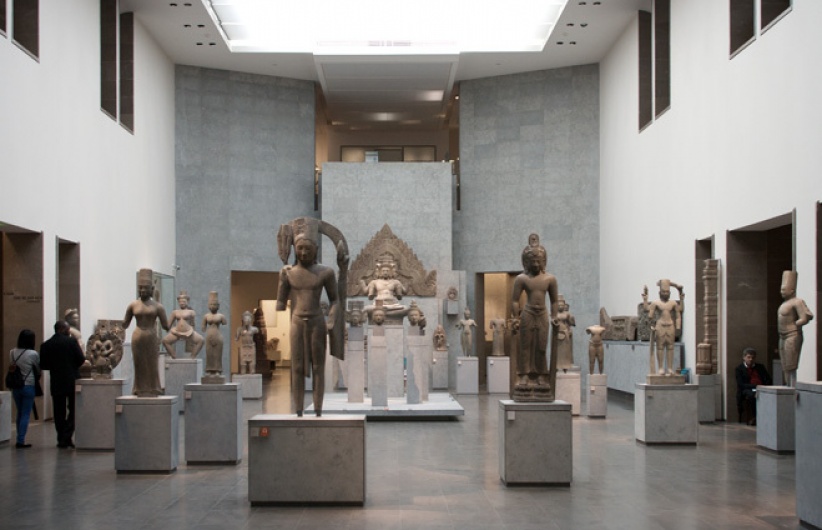
The Guimet Museum (Musée Guimet) is an art museum located in Paris, France. It has one of the largest collections abroad of Asian art.
Founded by Émile Étienne Guimet, an industrialist, the museum first opened at Lyon in 1879 but was later transferred to Paris. Devoted to travel, Guimet was in 1876 commissioned by the minister of public instruction to study the religions of the Far East, and the museum contains many of the fruits of this expedition, including a fine collection of Chinese and Japanese porcelain and many objects relating not merely to the religions of the East but also to those of ancient Egypt, Greece and Rome. One of its wings, the Panthéon Bouddhique, displays religious artworks.
Some of the museum's artifacts were collected from Southeast Asia by French authorities during the colonial period.
From December 2006 to April 2007, the museum harbored collections of the Kabul Museum, with archaeological pieces from the Greco-Bactrian city of Ai-Khanoum, and the Indo-Scythian treasure of Tillia Tepe.