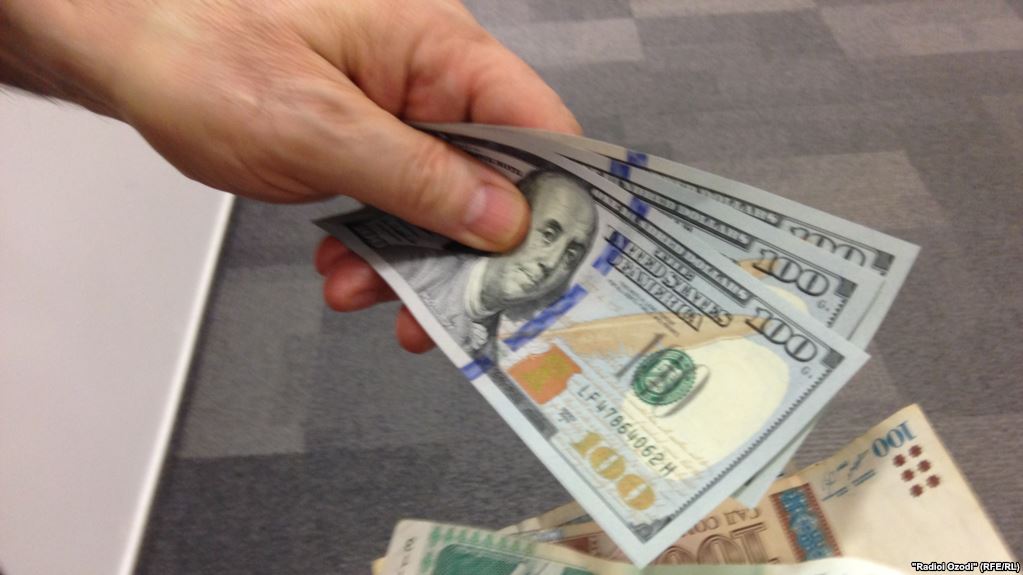
After the last correction carried out by the National bank of Tajikistan (NBT) in November last year, the exchange rate of the Tajik national currency, the somonis, against the U.S. dollar remains stable.
Moreover, the somoni has been gradually strengthening against the dollar since the beginning of the autumn.
On Friday October 8, an official exchange rate of the Tajik national currency, the somoni, against the U.S. dollar was set by the National Bank of Tajikistan at 11.2950:1 (0.25 percent increase compared to September 1).
After the last correction carried out by the NBT on November 4, 2020, the official exchange rate for 1.00 dollar was set at 11.30 somonis on November 20, 2020.
This was not the first correction. On March 20, 2020, the NBT changed the official somoni-dollar exchange rate by 5% at once.
Thus, considering the latest correction, the Tajik currency devaluated by 16.6% since the beginning of the year: from 9.69 somoni per dollar on January 1 to 11.3 somoni per dollar on November 4, 2020.
The official exchange rate is the rate of exchange announced by a country's foreign exchange administration, usually used by countries with strict foreign exchange controls.
The somoni has also been gradually strengthening against the euro since the beginning of the autumn.
On Friday October 8, the exchange rate of the somoni against the euro was set by the regulator at 13.0514:1 (2.6 percent increase compared to September 1).
After the last correction carried out by the NBT on November 4, 2020, the official exchange rate for 1.00 euro was set at 11.3510 somonis on November 20, 2020.
During a meeting with representatives of the World Bank that took place in Dushanbe on October 5, the first deputy head of the NBT; Jamoliddin Nouraliyev attributed the stable exchange rate of the somoni against foreign currencies to adoption of effective exchange rate policy and timely correction of the official rate.
According to forecast of the Tajikistan monetary policy for 2021 and medium term, the NBT’s exchange rate policy is based on the “floating regulated rate without determining and announcing the rate change limits.”
This regime presupposes setting an official exchange rate on the basis of supply and demand in the domestic market. In accordance with this regime, the regulator intervenes in the situation in the domestic foreign exchange market only in exceptional cases.
The NBT attempts to keep the difference between the official and market exchange rates of the dollar against the somoni at 2 percent. Thus, as of June 30, 2020, the difference between the official and market exchange rates of the dollar against the somoni was 3.2 percent (0.2 percent increase compared to June 29, 2019).
The market exchange rate refers to the real exchange rate for trading foreign exchange in the free market.
Meanwhile, independent experts say the stability of the somoni has been provided in recent year by the sale of the country’s gold reserves after appearance and spread of the novel coronavirus (COVID-19).
According to data from the Agency for Statistics under the President of Tajikistan, Tajikistan last year exported US$690 million worth of precious metals. Over the first eight months of this year, Tajikistan has reportedly exported US$708 million worth precious metals
Experts believe that artificial support for the national currency may lead to a sharp collapse of its exchange rate in the future.