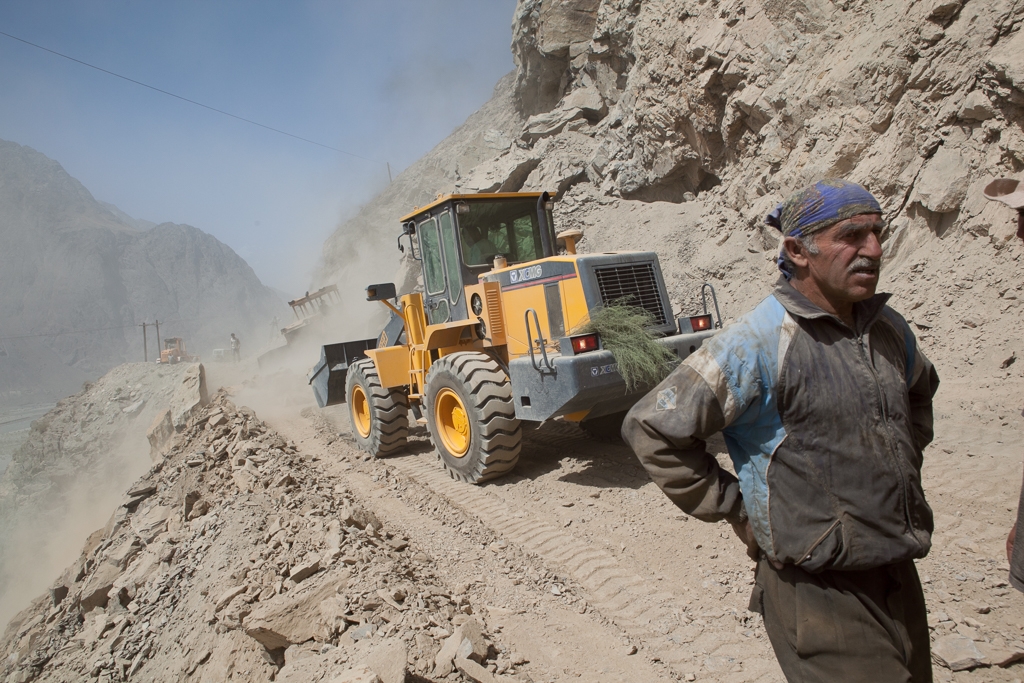
Tajikistan has formally accepted a US$125 million grant from China to upgrade a 90-kilometer section of highway in the Gorno Badakhshan Autonomous Region (GBAO). The amount is far less than Dushanbe expected to receive a few months ago.
Eurasianet says little of the money will pass through Tajik coffers; instead, China will pay Chinese contractors to reconstruct the stretch from Qalai-Kumb, the administrative center of Darvoz district to Vanj district.
The road was built during the Soviet period, but has not been renovated since independence.
Tajikistan’s lower house of parliament ratified the grant for 800 million yuan (equivalent to US$125 million) on October 18. Back in June, Tajikistan’s Minister of Transport Azim Ibrohim said China would provide US$204 million toward the project, leaving Tajikistan with a shortfall of about US$30 million. The ratification document seen by Eurasianet does not explain how the figure fell from U$204 million to US$125 million.
The eventual objective is to revamp the entire highway all the way to the Kulma Pass, which lies at a height of more than 4,300 meters above sea level on the border between GBAO’s Murgab district and China’s Xinjiang Uyghur Autonomous Region (XUAR).
A Chinese company will oversee the work, Radio Ozodi has reported; construction material and equipment will be exempted from import duties. So the grant amounts in substance to a subsidy to Chinese companies. And it is eventually Chinese freight companies that will by and large benefit from completion of the trans-Pamiri route.
It is not known how many workers will be brought in for the job or if Tajikistan will offer any other concessions. A Tajik government spokesperson declined to comment. The Chinese Embassy in Dushanbe does not answer questions from independent journalists.
China is Tajikistan’s largest source of finance. In recent years, China has stopped issuing the kind of large infrastructure loans that had mired Dushanbe in debt and turned instead to grants. In return, China gets tax breaks and access, often with little public oversight. China is heavily involved in mining in the country.