



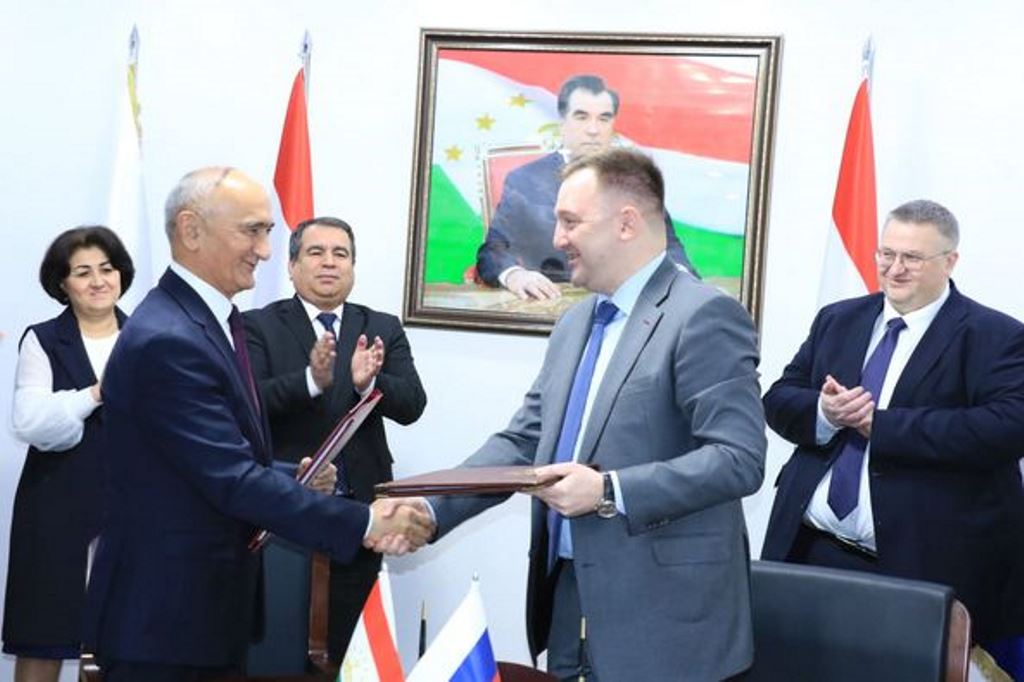
Two government-to-government agreements on cooperation between Tajikistan and Russia in the field of education were signed in Dushanbe on November 30, Ehson Khoushbakht, a spokesman for the Ministry of Education and Science of Tajikistan, told Asia-Plus Tuesday afternoon.
According to him, the documents were inked by Tajik Education Minister Mahmadyusuf Imomzoda and Russian First Deputy Education Minister Alexander Bugayev.
The documents determine the status of Russian teachers and principles of work provide of five Russian-language schools being built in Tajikistan under financial support of the Russian Federation.
“Imomzoda and Bugayev, in particular, noted that the Russian Teachers Abroad Project having been implemented in Tajikistan for already fifth year. Currently, 49 teachers are working in Tajikistan, teaching Russian language and literature, mathematics, physics, biology and other subjects in Russian,” Khoushbakht noted.
Meanwhile, TASS says that Russian Deputy Prime Minister Aleksey Overshuk, who is currently on a working visit to Tajikistan, noted on November 30 that Russia has allocated about 150 million U.S. dollars for construction of five Russian-language schools in Tajikistan.
A government-to-government agreement between Tajikistan and Russia on construction of five Russian-language schools in Tajikistan was signed in Moscow on April 17, 2019.
The agreement provides for phased construction of Russian-language schools in five cities of Tajikistan and equipping of them. Each of these schools will accommodate up to 1,200 pupils.
The construction of the schools is being financed by the Russian government. The schools are being constructed in the cities of Bokhtar, Dushanbe, Khujand, Kulob and Tursunzoda.
Recall, Russia at the start of the academic year 2018-2019 sent 30 teachers to secondary schools in Tajikistan. Teachers from the Russian regions of Kostroma, Kemerovo, Bashkortostan, Dagestan, and Tatarstan arrived in Tajikistan to teach subjects such as mathematics, physics, biology, chemistry, computer science, Russian, and others at secondary schools where teaching is conducted in Russian.
On October 15 last year, 50 Russian teachers arrived in Tajikistan to teach in 22 schools located in Dushanbe, Khorog, Khujand, Kulob, Bokhtar, Spitamen, Asht, Hisor and some other cities and districts. Only six of them arrived in Tajikistan for the first time, while others taught in schools in Tajikistan in 2019 and decided to return to Tajikistan again.
The education sector in Tajikistan has been in decline after collapse of the Soviet Union in 1991 and many Tajik nationals described the effort to bring over Russian teachers as a much-needed remedy.







