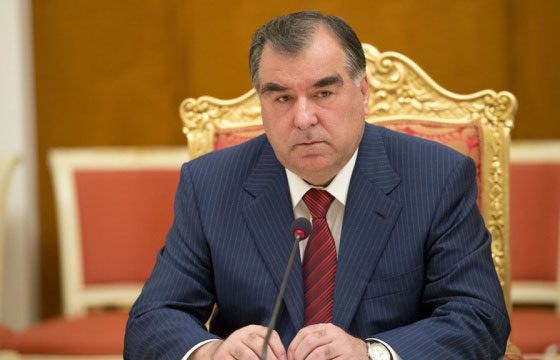
President Emomali Rahmon has left for the Russian city of St. Petersburg to attend the CIS informal summit.
Foreign minister, presidential adviser for international relations, defense minister and some other high-ranking state official are accompanying the president on his trip to St. Petersburg, according to the Tajik president’s official website.
Meanwhile, the Kremlin said in a statement that at the initiative of Russian President Vladimir Putin, a traditional informal meeting of the leaders of the member states of the Commonwealth of Independent States will be held in St. Petersburg on 28 December.
Participants in the upcoming summit reportedly include President of the Republic of Azerbaijan Ilham Aliyev, Prime Minister of the Republic of Armenia Nikol Pashinyan, President of the Republic of Belarus Alexander Lukashenko, President of the Republic of Kazakhstan Kassym-Jomart Tokayev, First President of the Republic of Kazakhstan Nursultan Nazarbayev, President of the Kyrgyz Republic Sadyr Japarov, President of the Republic of Tajikistan Emomali Rahmon, President of Turkmenistan Gurbanguly Berdimuhamedov, and President of the Republic of Uzbekistan Shavkat Mirziyoyev.
Established on December 8, 1991 after the dissolution of the Soviet Union, the Commonwealth of Independent States (CIS) is a regional organization. It now consists of Azerbaijan, Armenia, Belarus, Kazakhstan, Kyrgyzstan, Moldova, Russia, Tajikistan, Turkmenistan, Uzbekistan and Ukraine
On January 23, 1993, the Charter (Statutes) of the CIS was signed, setting up the different institutions of the CIS, their functions, the rules and statutes of the CIS. The Charter also defined that all countries have ratified the Agreement on the Establishment of the CIS and its relevant (Almaty) Protocol would be considered to be founding states of the CIS, as well as those only countries ratifying the Charter would be considered to be member states of the CIS (art. 7). Other states can participate as associate members or observers if accepted as such by a decision of the Council of Heads of State to the CIS (art. 8). All the founding states, apart from Ukraine and Turkmenistan, ratified the Charter of the CIS and became member states of it. Nevertheless, Ukraine and Turkmenistan kept participating in the CIS, without being member states of it. Ukraine became an associate member of the CIS Economic Union in April 1994, and Turkmenistan became an associate member of the CIS in August 2005. Georgia pulled out of the organization in 2009. Ukraine ended its participation in CIS statutory bodies on May 18, 2018, following prolonged tensions with Russia.