



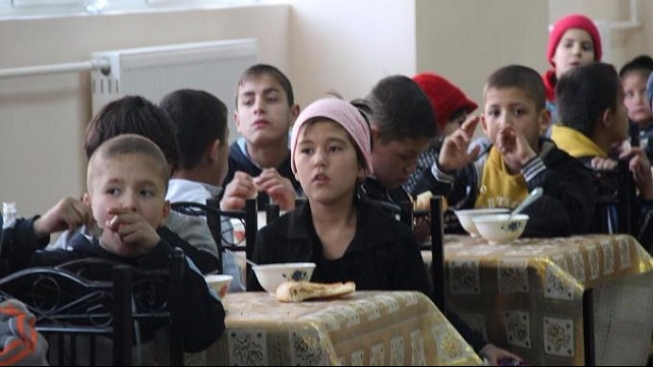
Tajikistan has raised the rates of pension for orphans. Now, an average pension of orphans in Tajikistan amounts to 232,90 somonis, Dilmurod Davlatzoda, the head of the Agency for Insurance and Pensions, told reporters in Dushanbe on February 7.
Meanwhile, an average pension for children having one living parent now amounts to 151.75 somonis in Tajikistan.
“To-date, 1,653 orphans and 79,453 children with one living parent have been registered in the country,” Davlatzoda noted.
In a report released at a news conference in Dushanbe, the Minister of Justice Muzaffar Ashouriyon noted on February 2 that the number of divorces has increased in Tajikistan.
“Last year, 13,741 divorces were reported in Tajikistan last year, which was 3,205 cases more than in 2020,”, the minister noted.
According to him, 14,814 children last year remained in the care of one of the parents as a result of divorces.
The experts consider early marriages as one of the reasons for divorces. Despite the fact that according to the Tajik legislation, it is possible to marry only after 18, early marriages are encouraged in the Tajik society. It is believed in Tajikistan that the sooner a girl is married off, the better wife she will become.
The government prohibits early marriage, but it does not stop some parents. It is believed that, according to Islamic law, a girl can be married earlier than the secular law allows, at 15-16 years of age, if she is sufficiently physically developed. Islamic cleric performs a marriage ceremony, “nikah.” Although, it is forbidden in Tajikistan to perform wedding ceremonies without a certificate from the registry office, some clergy believe that Islamic laws implementation is more important that secular ones.
The experts note that the number of divorces is constantly growing in Tajikistan. This reportedly leads to numerous problems, especially for young women, who are traditionally parented to become only wives and mothers. Young women are left alone without education and profession, with little children, often without support of their parents who cannot provide for them.
CABAR.asia noted in November 2020 that the number of divorces in Tajikistan grew five times over eighteen years: from 2000 cases in 2000 to 10,000 cases in 2018.







