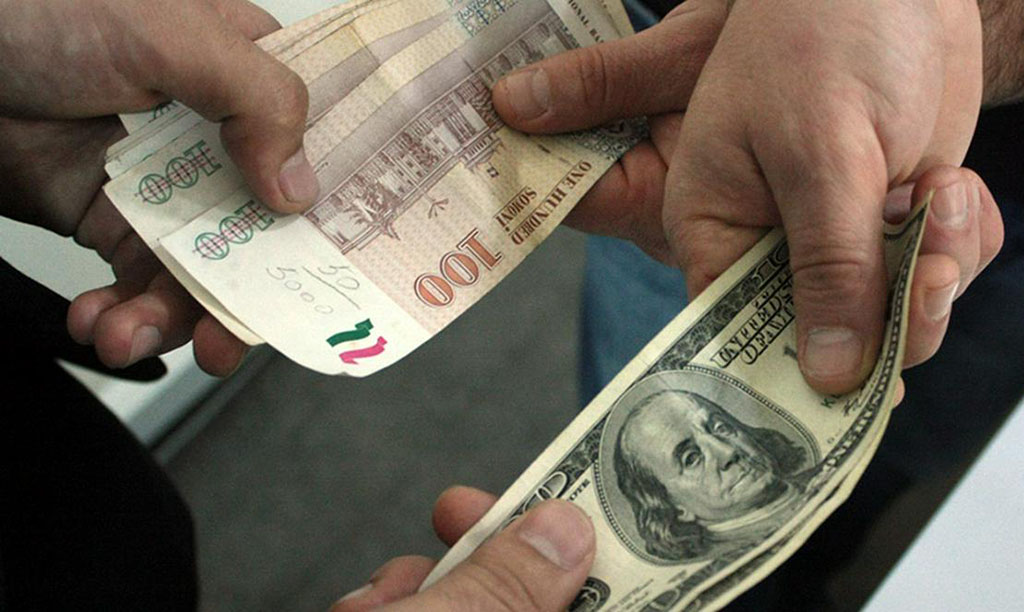
The National Bank of Tajikistan (NBT) says it has conducted a one-time adjustment to prevent the exchange rate pressure in the country’s currency market, sharp exchange rate volatility and the significant difference between the official and the unofficial rate.
An adjustment is the use of mechanisms by a central bank to influence a home currency's exchange rate. An adjustment is specifically made if the exchange rate is not pegged to another currency, meaning that the currency is valued according to a floating exchange rate.
Because the central bank intervenes in the home currency's exchange rate to reduce short-term fluctuations, this is considered a managed floating exchange rate.
At the official rate, the Tajik national currency, the somoni (TJS), has lost 15 percent of its value against the U.S. dollar (USD).
According to data from Tajikistan’s regulator, the official exchange rate of the somoni against the U.S. dollar fell from 11.3:1 on March 7 to 13:1 on March 9 (a 15-percent increase).
The somoni also lost 14.9 percent of its value against the Euro over the reporting period. Tajikistan’s regulator says the exchange rate of the somoni against the euro fell from 12.3488:1 on March 7 to 14.1908:1 on March 9.
Meanwhile, the current difference between the official and the unofficial exchange rate of U.S. currency rate is 15.9 percent, while the difference between the official and the unofficial rate should be no more than 2%.
The NBT says the main reasons for such a significant difference between the official and the unofficial rate are the increase in demand for and the reduction in supply of the dollar in the interbank market, the increase in demand for foreign currency on the part of importers of essential goods, decrease in remittances and the negative balance of the country’s foreign trade turnover.
Geopolitical tensions have worsened, after Russian President Vladimir Putin made the decision to hold a special military operation in Ukraine in response to the address of leaders of Donbass republics.
Experts say the Western sanctions imposed on Russia over the Ukraine crisis will put economic strain on many smaller countries with close economic ties to the Russian Federation.
One of those countries is Tajikistan.
Even before the recognition announcement by the Kremlin, the international financial ratings agency Moody's put Tajikistan — along with Armenia, Belarus, Kyrgyzstan and Moldova — on a list of countries most likely to be affected by sanctions on Russia.
A study by Moody’s in particular, says that if sanctions are imposed, they will affect the CIS countries, which have close economic, financial, and energy ties with Russia through various channels.
Experts note that if the Russian ruble devalues significantly, the currencies in Central Asia’s nations will also depreciate.
One of the first economic measures in Tajikistan that will be hit due to sanctions against Moscow are the many millions of dollars in remittances from the estimated more than 1 million Tajik labor migrants working in the Russian Federation.