An online talk of Ikat producers took place on March 16, connecting Bali, Dushanbe, Khujand and Margilan, according to the European Union (EU) Delegation to Tajikistan.
The goal was to exchange knowledge on Ikat production, design and techniques from Central Asia and Bali, to promote collaboration between producers and to make business contacts.
Participants of the talk reportedly included 100 ikat producers and business organizations for exports of crafts from Central Asia and Bali, as well as honored guests such as the Ambassador of Indonesia in Tajikistan and the Head of Dekranasda Bali: the Crafts Council of Bali.
The talk was reportedly organized in collaboration between the Bali project, Ikat Craft for Empowerment and a Better Livelihood, and the EU-funded project, Reviving Uzbekistan's and Tajikistan's Sustainable Ikat and Silk RUTSIS (RUTSIS).
To open a new perspective about Ikat, Balinese weaver & youth should learn ikat & style from various countries, to understand Bali ikat’s strength & weakness compare to others. Central Asia has ikat and similarity with Bali Ikat “Endek”, but has different styles of colors.
The project, Reviving Uzbekistan's and Tajikistan's Sustainable Ikat and Silk (RUTSIS), is being implemented within the SWITCH-Asia program funded by the European Union. The objectives of the project include the promotion of sustainable growth along the Great Silk Road in Central Asia, the contribution to the revival and upgrade of local silk and Ikat value chains, the integration of sustainable production approaches in an ethically and environmentally friendly way, strengthening cross-cultural dialogue between Uzbek and Tajik societies, creating new education and employment opportunities, safeguarding ancient silk and Ikat production techniques, and developing innovative sustainable design and enhancing recognition of Central Asian sustainable silk and ikat products in the international market.
The project is implemented by a consortium of organizations and consulting companies from Germany, Tajikistan and Uzbekistan, in particular: adelphi consult GmbH (Germany), the Chamber of Commerce and Industry of Tajikistan, the Chamber of Commerce and Industry of Uzbekistan, the NGO Tourism Development Center (Tajikistan), the NGO Center for the Development of Crafts Margilan (Uzbekistan) and Burg Giebichenstein University of Art and Design Halle (Germany).
Ikat (in Indonesian languages means "bind") is a dyeing technique originating from Indonesia used to pattern textiles that employs resist dyeing on the yarns prior to dyeing and weaving the fabric.
In ikat, the resist is formed by binding individual yarns or bundles of yarns with a tight wrapping applied in the desired pattern. The yarns are then dyed. The bindings may then be altered to create a new pattern and the yarns dyed again with another color. This process may be repeated multiple times to produce elaborate, multicolored patterns. When the dyeing is finished all the bindings are removed and the yarns are woven into cloth. In other resist-dyeing techniques such as tie-dye and batik the resist is applied to the woven cloth, whereas in ikat the resist is applied to the yarns before they are woven into cloth. Because the surface design is created in the yarns rather than on the finished cloth, in ikat both fabric faces are patterned.
There are many theories about how ikat came to Central Asia. Some claim the technique existed as far back as the 10th and 11th century but most sources attribute it to the 18th century. The largest center of manufacturing silk ikat was, and still is, in the Fergana Valley (Margilan) in Uzbekistan. In the early 20th century Margilan had 120 workshops with a division of labor split by technique–some of the workshops processed the raw yarn, some engaged in dyeing, and others did the weaving. This system is still reportedly being followed today although the existence of workshops is less due to the suppression of this tradition during the Soviet era. But yet, Margilan still has the reputation for the best quality materials.
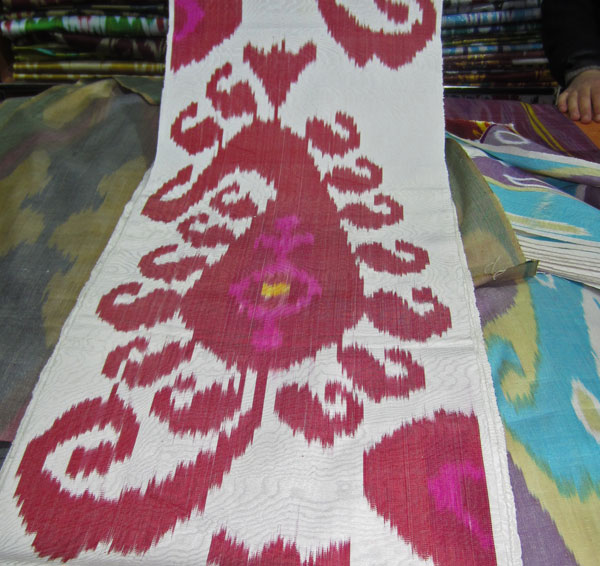
Central Asian ikats are characteristically large bold designs. Bright primary colors such as red, yellow and blue (and their variations) are made from natural colorants. Some of the typical motifs are pomegranates, tulips, trees, ram’s horns, birds, scorpions, and spiders. As the weaving has become more commercial, the designs have been simplified.