Tajikistan’s economic growth is projected to slow in 2022 because of the severe spillover from the expected economic downturn in the Russian Federation, but is expected to recover slightly in 2023, says a new Asian Development Bank (ADB) report.
The Asian Development Outlook (ADO) 2022, ADB’s annual flagship economic publication, in particular, notes that after a strong economic rebound to 9.2% in 2021 from 4.5% in 2020, Tajikistan’s gross domestic product (GDP) growth is forecast to slow to 2% this year.
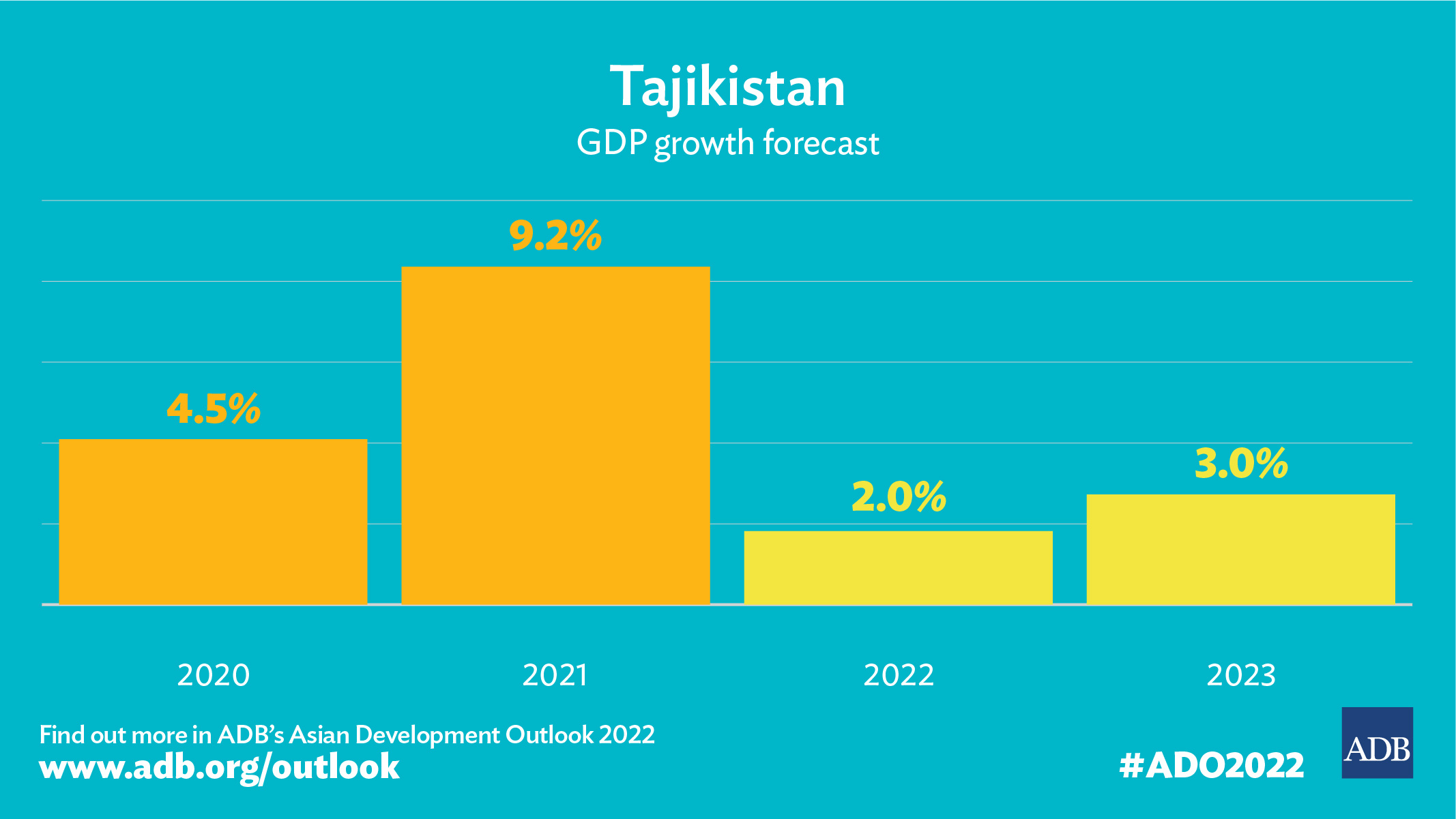
Growth is reportedly expected to rise to 3% in 2023 driven by gains in industry and emergency assistance from development partners to support consumption.
“Following strong economic growth in Tajikistan last year, the picture is clouded this year due to geopolitical uncertainty. The impact of this turbulence on the Tajikistan economy is yet to be fully seen and assessed, and ADB may update its projections as the situation evolves,” said Officer-in-Charge of ADB’s Tajikistan Resident Mission Rhodora Concepcion.
Inflation, which slowed to 8% in 2021, is projected to reach 15% in 2022, reflecting higher prices for fuel and imported food, and pressure on the somoni from a plummeting Russian ruble.
The projection reportedly also reflects expected increases in public salaries and pensions, and higher electricity tariffs. In 2023, inflation is projected to drop to 10% with moderating global food and fuel prices.
The report highlights the importance of maintaining debt sustainability for macroeconomic stability.
Various initiatives can strengthen debt sustainability, including maintaining the prohibition on nonconcessional external borrowing; using cost–benefit analysis when selecting public investment projects and limiting the size of the investment budget; and improving the performance of loss-making state-owned enterprises (SOEs).
The report suggests promoting private sector growth through measures to improve the investment climate; reducing reliance on external borrowing by developing the domestic capital markets, including a secondary market in government securities to encourage commercial banks and other parties to buy and hold government debt; and regularly publishing Ministry of Finance reports on public debt, including audited annual statements of the 15 largest SOEs.
The government may also consider limiting fiscal deficits to 2.5% of GDP by cutting low-priority capital expenditure, phasing out tax exemptions, prioritizing spending more effectively, assessing public investment management, evaluating fiscal transparency, and addressing any shortcomings revealed, according to the report.
Since Tajikistan joined ADB in 1998, the bank has become the country’s largest multilateral development partner with $2.3 billion in total assistance, including over $1.7 billion in grants. ADB’s 2021–2025 country partnership strategy for Tajikistan focuses on three strategic priorities: structural reforms to enhance resource allocation and mobilization, improving labor productivity through human capital development, and fostering better livelihoods by investing in the land-linked economy.
Established in 1966, the Asian Development Bank is owned by 68 members—49 from the region.