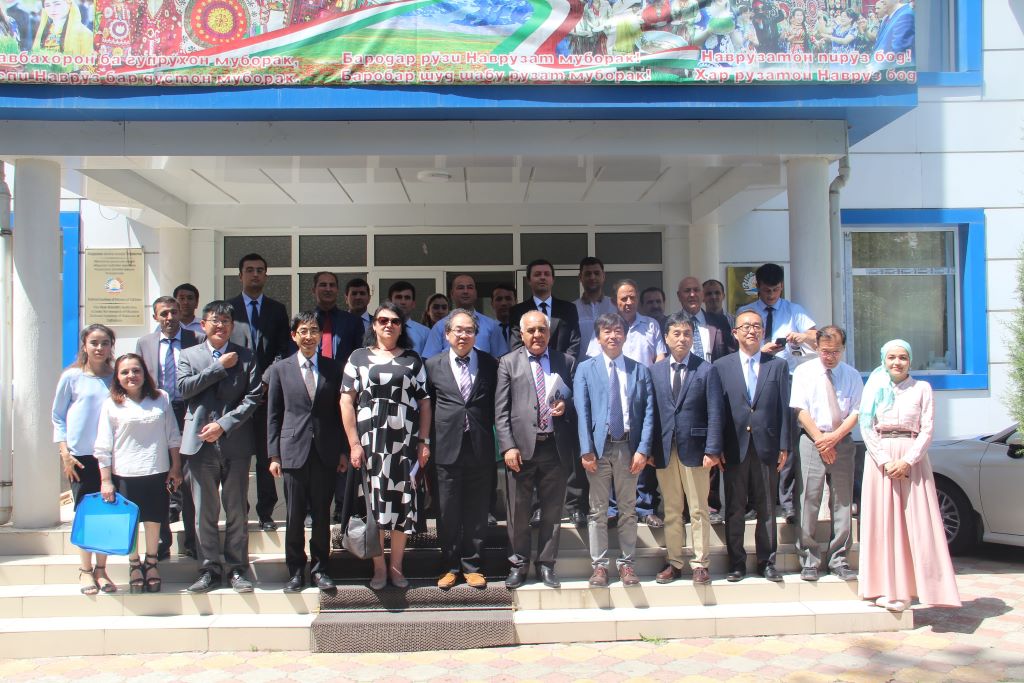
In line with the strategic goals of Tajikistan set in the National Development Strategy for the period up 2030, especially access to energy (security), environmental protection and public health, the Government of Tajikistan requested the Government of Japan the project for exploring the ground heat sources and enhancing institutional capacity for developing and utilizing decarbonized heat energy supply system through the Japan International Cooperation Agency (JICA) program “Science and Technology Research Partnership for Sustainable Development (SATREPS)”, according to JICA Tajikistan Office.
On June 16, the Kick-off Symposium of the SATREPS Project for Development of Decarbonized Heat Energy Supply System using Ground Heat Source was held at the National Academy of the Sciences of Tajikistan. The Symposium was attended by representatives of the National Academy of the Sciences of the Republic Tajikistan, Embassy of Japan in Dushanbe, JICA Tajikistan Office and the Center for Innovative Development of Science and New Technologies of the National Academy of the Sciences of Tajikistan (CIDNST) and others.
The overall goal of the project is to make the High-efficiency Ground Source Heat Pump (GSHP) system, which is a heating/cooling system with low carbon dioxide emission, for arid regions available and spread in Tajikistan. In the Soviet era, small coal boilers installed in schools and hospitals for heating, but continuous use of small coal boilers is not preferable from the viewpoint of greenhouse gas emission and air pollution. Therefore, replacing these facilities with ground source heat pumps, which do not use fossil fuels, is one of the influential measures.
The duration of the project will be five (5) years, from May 2022 to April 2027. During the project implementation period, JICA experts will train their Tajik counterparts at the Center for Innovation Development of Science and New Technologies on the development of GSHP potential maps, jointly create a demonstration plant and complete the institutional design for the introduction of GSHP system.
The project designed to contribute to cope energy security and climate change issues and elaborated under the framework of Japan launched program called “SATREPS” that strives to resolve global issues. The project will be carried out through the collaboration of leading Japanese research institutions headed by the Akita University and the consortium of their Tajik counterparts, headed by the Center for Innovation Development of Science and New Technologies of the National Academy of the Sciences of the Republic of Tajikistan. This is the first SATREPS project in Tajikistan.
With accumulated knowledge of geothermal, including GSHP, Japan can be an appropriate partner of Tajikistan for developing its geothermal sector and JICA Tajikistan Office hopes to promote such cooperation when Japanese and Tajik research institutions work together based on the social needs of the population of Tajikistan.
JICA began its technical cooperation with Tajikistan in 1993 by inviting Tajik officials to gain knowledge and experience on governance and macroeconomics development. As of March 2020, a total number of participants to JICA’s Knowledge Co-Creation Programs, formerly called the Training Programs, has exceeded 2380 people. JICA Office was established in 2006 in Tajikistan and since then various Grant Financial Assistance and Technical Cooperation projects have been implemented more dynamically, aiming at improving living standard of Tajik people for the sectors such as agriculture and rural development, water supply, health, transport, energy, capacity building as well as SME promotion. JICA’s cumulative investment portfolio in Tajikistan in all sectors comprises 44 projects amounting to more than 418.5 million USD (94.66 million USD for Technical Cooperation and 324 million USD for Grant Assistance), including 14 ongoing projects.